
Q1. Could you please start by introducing yourself to our readers?
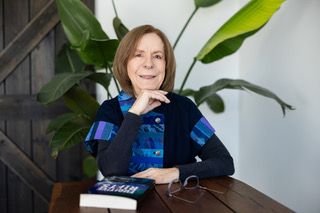
A1. Hello and thank you for providing me with the opportunity of talking about “Spelldrifts,” my second novel.
My name is A-M Mawhiney. I grew up in mainly single-industry mining and farming communities in Northeastern Ontario leaving only to complete my post-secondary education at three different universities.
When I was a child I declared I wanted to be a writer but instead became a social worker and then a professor at a small university in Northern Ontario Canada. When I retired in 2018 I never imagined that I would realize my childhood dream of writing. In March 2020, overwhelmed during the first lockdown of the Covid pandemic, I opened my laptop and started to write. What escaped from my fingers became the first sentence in my debut novel, “Spindrifts.” I am now a self-published author of three books: “Spindrifts” (2021), “Spelldrifts’ (2023), and “Fugitive Rifts’ (2025), all supported with services by FriesenPress.
Q2. In your view, what distinguishes a writer from an author?
A2. This is a very good question because, for me, there is a blurry distinction between the two. It is up to the individual, of course, to identify themself as either a writer or an author.
Some will likely disagree with my answer. Many outstanding writers choose never to publish. They might journal or write diaries, create poetry or prose for a variety of reasons other than a desire to publish. I would call them writers: people who spend time regularly writing, whether non-fiction or fiction, for the love of writing and, perhaps, for sharing what they have written to a select audience. For example, I know of a local group of writers who challenged each other to write poems and then read them to each other at regular gatherings. One published her poem, and the rest were happy to write and share their poetry with the group.
Authors, in my opinion, are writers who decide to seek publication of their writing and therefore also become immersed other activities related to being an author, including, for example, engaging technical support for editing, design, and other activities leading to publication. They are also active in pre- and post-publication activities like book promotions, writing articles, speaking at literary festivals and community forums, being on or hosting podcasts, and attending public events.
In my opinion, there is no hierarchy between a writer and an author. Both write and some publish what they write. There is creative excellence in both groups, but one may be more private and the other more public about where their writing is found.
Q3. Which part of your book “Spelldrifts” proved to be the most challenging to write, and why?
A3. There were two writing challenges with “Spelldrifts”.
Because this is a stand-alone sequel to “Spindrifts” I had to shift my world-building because the stories are twenty years apart and the world transformed in significant ways between the two stories. I also had a request from two pre-teens to include a dragon and a wolf in “Spelldrifts.” That required a lot of creative thought to develop a backstory that could explain how a dragon appeared in a future version of Earth, when there was no hint of such a creature in the first book. Developing the character of the dragon was initially daunting but, to my surprise, Chiyo emerged clearly as I was writing.
The second challenge was writing the climax to the story, which involved a battle between factions, in a world that valued working together with mutual respect and inclusion for everyone. A battle seemed the very antithesis of the ways of living in the world I created for “Spelldrifts,” but it became necessary to defend all that was good in that world.
Q4. How do you typically celebrate once you’ve completed a book?
A4. It is a quiet moment for me. I tell family and friends and then enjoy a rich hot cocoa and start to plan the launch, which is the public celebration to send out word that I have a new book.
Q5. How do you leverage social media to connect with your audience as an author?
A5. I spend dedicated time almost daily on social media. I have accounts with Twitter/X, SubStack, Instagram, Blue Sky and Threads. I have stepped back recently to think about new social media strategies and will be back in full force soon on all these platforms.
Q6. On average, how many hours a day do you dedicate to writing?
A6. Times vary. I seldom take a day away from some aspect of writing, publicity, and promotions. I spend anywhere from 3-14 hours a day. When I am immersed in my story I rarely am away from my desk and, even when I am, my mind is most often engaged in thinking about what comes next. When I am focussed only on promotions and publicity, between publications, I spend fewer hours each day and take more breaks.
Q7. What kinds of books did you enjoy reading during your childhood?
A7. Even as a child I was a voracious reader and read every day since I was six years old. I read mysteries like Trixie Belden, Hardy Boys, Nancy Drew. Polly Anna and Anne of Green Gables were difficult reads for me because I felt sorry for Anne and Polly Anna. I adored Maggie Muggins. Then there was the infamous moment when I was eight years old and my mother discovered me reading a racy adult novel, because I had read all the children’s books. My parents decided to let me finish it.
Q8. Is there an author within your genre whom you particularly admire?
A8. I have been enjoying a trio of books by Anne M. Smith-Nochasak, The Taggak Series, and also P.L. Stuart’s Drowned Kingdom Saga. These are great fantasy books by emerging Canadian authors.
Q9. How has the experience of writing and publishing a book “Spelldrifts” influenced your perception of yourself?
A9. Writing “Spelldrifts” opened up hidden talents when it came to writing my own version of fantasy. It turns out I have a vivid imagination! Normally perceived as quiet and straightforward, I now feel much more confident about my ability as a writer to dig deep and write something way out of what used to be my comfort zone. More than the other two books, “Spelldrifts” relied on my ability to formulate my own vision of characters and magical powers when it came to the fantasy elements.
Q10. If you had to describe yourself using just three words, which would you choose?
A10. Thinker. Dreamer. Hopeful.
Buy a book on Amazon
 Sassy Reviews