Interview with author Hilda Torres

  1. Please introduce yourself so that the readers will get to know you better.

My name is Hilda Torres. I am a wife, mother and grandmother. I Have lived in sunny South Florida my whole life. My family immigrated here in the late 60s when we fled communist Cuba. I studied English Literature at St. Thomas University and I’ve always had a passion for books and reading. I have a son who is 33 years old and has autism. Because of this my life took a different turn and I started teaching special needs children in elementary level. I was part of the first programs to integrate children with autism into our public schools. As my son got older I decided he needed me full time and dedicated myself to his care. I’ve tried over the years to raise autism awareness and understanding.

I wrote this book in order to give the autism community a different kind of voice. Something that teaches, brings understanding but is also fun and relatable.

  1. What is your inspiration behind your book “Tonio and Bear’s Adventures: Day at the Zoo”?

My inspiration for my Tonio and Bear is my son. This book and the others in the series are all based on true events that have happened with my son. Bear is a true character in my sons life and decided I wanted to bring him to life.

  1. When did you realize you want to be an author?

I have always loved books and loved to read. Things get complicated as our lives change but I use to read several books a week. It was my passion. I always thought, what would it be Iole to actually write one. But I never seriously considered it until the idea for this book came to me some years ago.

  1. Please tell us something about your book “Tonio and Bear’s Adventures: Day at the Zoo”?

Tonio is our little hero. He loves to experience different adventures. But he has some setbacks. Sometimes his autism can make things challenging. He needs help in order to be able to have fun and go on these adventures. Someone who loves him, understands him and also understands and knows about autism. This is where Near comes in. Together they go on these great adventures and Bear is equipped to help Tonio be able to get past some difficult moments in order to have some great fun. The first book in the series is an adventure at the zoo. Let’s see what’s next for our little hero and his trusty companion.

  1. For which age group is your book “Tonio and Bear’s Adventures: Day at the Zoo” suitable for?

I’m general it’s mostly for children between 5-8 years of age. But remember there are many older kids and adults on the spectrum who might really like this book.

  1. What is your favorite Quote?

Trust in the LORD with all your heart
And do not lean on your own understanding.
In all your ways acknowledge Him,
And He will make your paths straight.

  1. What do you like the most about your country?

I love my country. I was not born in the United States but I came here very young. My family and I fled communism and oppression. This country opened their doors to us and gave us freedom and opportunities that we could not have had anywhere else.

I became an American citizen as soon as I turned 18. I couldn’t wait to vote and be part of the process of this amazing country.
This country was founded on values and principles by men who knew what it was like to not have freedom of speech or religion. Our U.S. The Constitution is one of the most beautiful and important documents ever written.

  1. What suggestion do you want to give to parents of little readers regarding a reading habit?

It is so important to teach our children to read. We can start while they are still in the womb. Then we should continue to read to them as infants and let them grow up knowing that books are part of their lives. They will want you to read to them and eventually want to read for themselves and to acquire knowledge. If you read to your children from a very early age they will develop better language skills and do much better in school.

  1. What does literary success look like to you?

If this series of books can help families who are struggling with the overwhelming challenges of autism then my book is a success. If just a few families can say this book made a difference, not just because my child liked it but also because his/her piers liked it or maybe people they know have a better understanding of autism after reading it, that’s success. If teachers and therapists can use it to help their special needs kids, that’s success.

  1. Lastly, who is your inspiration in life and why?

Well first and always, my inspiration is Jesus Christ my Lord and Savior, he inspires me to be better to stay strong to try and help others. He gives me strength thru the suffering and shows me mercy and light in the daily miracles.

My son inspired me to do this book and his struggles in life have been so difficult. He makes me and all who know him better human beings.

My daughter inspires me. She has dedicated herself to helping children find their voice. She is an amazing Speech and Language pathologist, SLP. The dedication she has to her clients and students is beautiful. She’s making a difference.

Buy Tonio and Bear’s Adventures on Amazon

Interview with author Laurence Baillie Brown

Q1. Hello, can you please introduce yourself? Readers would love to know more about you.

I’m Laurence, now in my sixties, born in Hull in the North of England, and – key facts – I’m both Jewish and gay, 2 attributes that don’t always sit easily together! I spent nearly 40 years teaching English Law, but my great passions have always been writing (both fiction and poetry) and music (especially playing classical piano.) In the 80s and 90s I was very active writing for the gay press in London (where I have lived for many years.) I published my first novel ‘Addictions’ back in 2000 (Gay Men’s Press.) I’ve had two 10-year relationships with male partners in my life, but now I’m happily single.

Q2. What were the key challenges you faced while writing your book “At the Court of Broken Dreams”?

I’ve been fascinated by history – and historical novels – since I was a child, but my focus was always the Tudors and Stuarts (and the ancient Greeks!). When the skeleton of Richard III was discovered – mysteriously – under a Leicester car-park, I became intrigued by the story and by the King’s hotly disputed character. At the same time I remembered the De-la-Poles – Hull’s most famous medieval family – who rose from local vintners to Royal Dukes in just 3 generations. I also wanted to write a story about a love – romantic love – between men, in a historical period when there was no concept of being ‘gay’ or even ‘homosexual’. For these reasons I have deliberately left open the issue as to whether the two ‘bromances’ my narrator Eddie has in the book are sexually realized – because in the end that’s not the most important thing. The biggest challenges were: to research the Wars of the Roses period (which took about 3 years); to use language – including some medieval English – which would not sound anachronistic; and, most important, to wear all this lightly and write a readable and I hope gripping – and moving – story.

Q3. What books or authors have most influenced your own writing?

In writing this book I fell back on my favourite historical novelists: Robert Graves (‘I, Claudius’); Gore Vidal (the brilliant ‘Narratives of Empire’ series); and the spell-binding but largely forgotten Mary Renault, who wrote wonderful novels set in classical Greece (e.g. ‘The Bull from the Sea’). I also adore England’s 2 greatest novelists: Jane Austen (‘Persuasion’ etc) and George Eliot (the brilliant ‘Daniel Deronda’ which deserves constant re-reading.) I wouldn’t presume to say they have influenced me.

Q4. What’s your favourite spot to visit in your own country? And what makes it so special to you?

This is difficult to answer, as I’m much more historically than geographically inclined. Hull is still important to me, but mainly in my imagination. My favourite English city is probably Brighton, a colourful, historic resort on the south coast, which has the sea (I miss that), the fantastical Royal Pavilion (built by the Prince Regent) – and a brilliant gay life!

Q5. What inspired you to write the book ‘At the Court of Broken Dreams’?

Trying not to repeat myself, it was the confluence of my passion for historical fiction, the extraordinary discovery of King Richard III’s bones, my fascination with the fifteenth century (important to me because that was when my alma mater King’s College, Cambridge was founded by the tragic King Henry VI, who also appears in the book), my desire to write a ‘real’ love story between men, and, I should add, my fascination with the ambivalent status of the Jewish faith and community in the late Middle Ages.

Q6. How long did it take you to write your book ‘At the Court of Broken Dreams’?

As I remember, about 3 years for the research, followed by about one year’s writing. At that point – half way through the story – I had some sort of mental and physical breakdown, which unsurprisingly held things up for about 3 years! Then, as a part of my recovery, I began reading – and writing. It took about another year to complete and revise the novel. I finished it in the Spring of 2022 and, having had some bad experiences with publishers, decided to publish independently. Which is brilliant in terms of choosing one’s own cover-art etc but is also deeply frustrating e.g. the mainstream press clearly believe all independently published novels are crap as they won’t even look at one before refusing to review it. Talk about narrow-minded. As a result of that, I would prefer to have a major publisher for my next novel…if I write one!

Q7. On what platforms can readers buy your books?

My novels – there are now 3 out there – are all available from Amazon, Waterstones, Barnes and Noble and quite a range of independent bookshops (which delights me.)

Q8. Tell us about the process of coming up with the book cover and the title ‘At the Court of Broken Dreams’?

I simply don’t know where the title came from, but I had it from the first concept and it never changed. It also has a ‘sub-title’: ‘Love and War in the Middle Ages’ which is probably more informative.
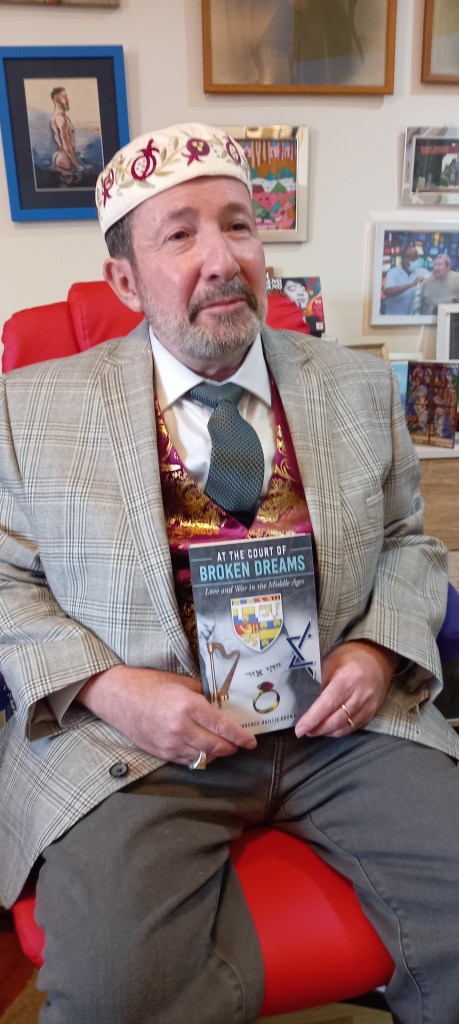
The covers are a combination of key images in the story, which I chose: the male torso with Hebrew text ‘written on the body’ (it reads ‘Let there be light’); the harp, which is Eddie’s instrument; his ruby ring; and at the top, the authentic coat of arms of the Earls of Suffolk, Eddie’s ancestors.

Q9. When writing a book how do you keep things fresh, for both your readers and also yourself?

In writing this book I can assure you I had no need to keep it fresh as I was totally driven, from beginning to end. I was utterly fascinated by the characters, who, after a while, began to tell their own stories.

Q10. What is the most valuable piece of advice you’ve been given about writing?

On writing historical fiction, I was given the excellent advice not to wait to start writing until you’ve finished your research – because you never will.
On writing generally: I think it’s from ‘Aspects of the novel ‘ by the wonderful E.M. Forster (‘Passage to India’) who said something like: say just what you want to say, as clearly as possible, then stop. And also that the most important quality in any novel is the “and then…and then” quality. The man was a genius. Sadly he died just about a year before I went up to King’s College Cambridge, where he had been a life Fellow.

Buy At the Court of Broken Dreams on Amazon

Interview with author Lisa Kelly

1. Please introduce yourself so that the readers will get to know you better. 

Hello! My name is Lisa Kelly and I’m a graduate of the University of Notre Dame. I have written five books, all revolving around Notre Dame. Three non-fiction books about former athletes and their stories of how they got to Notre Dame, what their experience was like when they were in school, and then where their lives went after sports. My fourth book is a Notre Dame football cookbook filled with the favorite recipes of former Notre Dame football players, coaches, student managers and leprechauns. And my new book is my first children’s book, Clover Goes to Notre Dame … a story of a French Bulldog’s first trip to Notre Dame on a football Saturday.

2. What is your inspiration behind your book “Clover Goes to Notre Dame”?

I went to college at the University of Notre Dame from 1989-1993. I absolutely love my school, and I love my animals. For years, twenty-eight to be exact, I sent my loved ones Christmas letters penned in the voice of my pets. First, I wrote using the voice of my cats, Taz and Puzzle. Then I continued with my dogs, Hailey and Molly. And now the letters are “written” by my current dog, Clover. Clover is a playful, quirky, and funny French Bulldog. When I decided to write a Notre Dame children’s book, I knew she would be the perfect narrator. I hope you love seeing the Notre Dame campus through Clover’s eyes. For me, it has been a joy to create and share this fun and whimsical tale.

3. When did you realize you want to be an author? 

About 10 years ago I decided that the world didn’t have enough positive stories and inspiration, and that is what lead me to writing my first book, Echoes From the End Zone: The Men They Became.

4. Please tell us something about your book “Clover Goes to Notre Dame”? 

Meet Clover, a French Bulldog with a nose for adventure and more than a touch of luck. “A clover reminds us to keep faith, love, and hope in our hearts,” my mom says. What else will Clover learn on her very first visit to her mom’s alma mater? Follow this little Frenchie through Father Sorin’s big college campus and straight to the heart the Notre Dame family.

5. For which age group is your book “Clover Goes to Notre Dame” suitable for? 

4-8 years old (or Notre Dame fans big and small!)

6. What is your favorite Quote? 

I can’t believe that God put us on this earth to be ordinary. – Lou Holtz, former Notre Dame head football coach

7. What do you like the most about your country?

I love the opportunities this country gives us to pursue our dreams, whatever they may be!

8. What suggestion do you want to give to parents of little readers regarding a reading habit? 

Reading is the best habit you can give your children. It teaches them to communicate better, it broadens their imagination, and it lowers their stress levels.

9. What does literary success look like to you?

Literary success is when I get a positive review or email from someone I don’t know. It makes me so happy to see people enjoying my work!

10. Lastly, who is your inspiration in life and why? 

My mom and dad are my inspirations because even in their 70s and 80s they are both avid readers and are always looking to learn new things. I truly believe reading helps them keep their minds sharp.

Lisa Kelly’s Website

Interview with author Stephen D. Curtis

Q1 Hello, can you please introduce yourself?

Hello! My name is Stephen David Curtis, and I am the author of the supernatural thriller: Circle of Innocents. I must confess this is a little strange for me, as I am not one who generally enjoys talking about himself, but on this occasion I will make an exception!

I suppose the best place to start would be the place of my birth, which happens to be the city of Chelmsford, in Essex, a county in the South East of England. This was where I was to spend the first four years of my life before moving with my family to Letchworth, a small town located just thirty miles north of London in North Hertfordshire.

With the exception of the past two years where I have been a resident of Cambridgeshire, the North Hertfordshire area is where I have spent the vast majority of my living years. I was educated there, I grew up there, and I worked there, so I guess it should come as no surprise that North Hertfordshire would have ended up being the setting for Circle of Innocents.

I left school (having had a standard, state education) at the age of sixteen, choosing to go into full time employment rather than stay on to get further qualifications, or go on to college or university. As a consequence, I don’t have a degree or letters after my name, but I do sign up to being a graduate of the “University of Life”. I been very fortunate in my fifty-nine years on this wonderful planet to have known some amazing people, some of whom were musicians, and it is to these individuals that I have to give thanks for the four decades I spent in the music industry as a performing artist, guitarist, songwriter, and lyricist.

Poetry and creative writing were a part of my school life. It was a means of escape in some ways, but I also learnt the true power of the written word at the same time. This would morph into writing lyrics as my musical career began to take shape, the emotivity of words combined with the power of music. I guess the passion I felt then still burns inside me, and, undoubtedly, it always will, but my pathway has since changed, and I shall leave that particular road to now be travelled by my two grown-up children, because yep, you guessed it…this Old Rocker’s, Rock ‘n’ Roll genes have managed to find their way into his offspring! My twenty-three-year-old daughter, is a singer, songwriter and performer, and my twenty-seven-year-old son, is an extremely gifted guitarist and graphic artist. They are two, truly talented young people, and I am immensely proud of them.

Well, that’s pretty-much me in a nutshell. I could have gone into more detail about being a keen golfer and budding bonsai artist as well, but you might well have lost interest by then!

You’re still with me, though, aren’t you…?
Great! Let’s see what else might be about to come out!

Q2 What were the key challenges you faced while writing CIRCLE OF INNOCENTS: It Must Remain Unbroken…?

That’s a very good question…

To begin with, the biggest challenge I had to face was the fact I had never written a book before! Sure, I had an idea for a story and I knew I had an imagination, but where the heck was I even going to begin?

Oddly, the beginning came about by writing what I perceived would be a likely end to the story. By getting a feeling as to where the book was going, I was able to form the skeletal plot onto which I could slowly add the flesh of developing characters, twists and subplots.

And developing those characters and making them all relatable was another challenge. In life, everybody we meet has a backstory, a reason why they are the way they are. Life’s experiences shape us, and it should be the same for fictitious characters in a book. Making every character in a story as strong as possible is vital. Characters are often the heart and soul of a book, making us react to them as we embark upon their respective journeys. Authors can make us feel what their characters are going through, and the words on a page can almost make us feel that we are even looking through a character’s eyes.

In truth I learnt pretty-much as I went along to begin with, planning one chapter at a time, and then I came upon the challenge of continuity. What we write in one chapter will affect what might happen later on, and if we decide to strengthen an earlier scene or idea, then we really have to think very hard about the consequences further down the line. Not being a full-time writer, there were days when I didn’t write at all, I had to pick the thread back up again, and sometimes this could be problematical. There might well be other authors reading this right now, tearing their hair out about my probable total lack of professionalism, but this was my very first attempt at creating a novel, and the point I want to make is that I improved considerably as I wrote. Once I was into the flow, the characters developed along with the story, and the writing became easier.

Q3 What books or authors have influenced your own writing?

If you are asking if any author or book has directly influenced my writing style, then I would have to say no, but I do have a penchant for reading Supernatural / Horror Thrillers, which is undoubtedly the reason why I ended up writing such a novel, myself!

James Herbert is the first author I read from that genre when I was a very young man. I remember reading a number of his books: The Rats, The Lair, The Fog, and The Survivor among several others.

The number of books by Steven King that I have read since are too numerous to mention, and then there is Clive Barker and Dean Koontz, two more incredible authors whose works I have always considered being nothing short of exceptional.

To be able to write as prolifically as all these famous names, and as consistently well, is something to which I can only aspire, so I would accept that my aspirations to attain those self-same levels of creativity, is, in itself, because of the influence that those great writers have had upon me.

Q4 What’s your favourite spot to visit in your own country? And what makes it so special to you?

To narrow the beauty of the British Isles down to one favourite spot is nigh on impossible for me. For one thing, as an island, we have thousands of miles of coastline, some of which is nothing short of spectacular. Then, of course, there is the Peak District, the Lake District, Snowdonia in Wales, and the magnificent Scottish Highlands among many other sites too numerous to list right here.

But one stretch of England I once visited did have a very profound effect upon me, and what I am about to say may well surprise a few people. I am talking about The Ridgeway, a prehistoric trail and broad track in the south of England once used by ancient travellers, traders and herdsmen. The trail runs for eighty-seven miles from Avebury in Wiltshire (site of the famous Avebury Ring), to Ivinghoe Beacon in Buckinghamshire, passing through the North Wessex downs, and the woodlands and valleys of the Chiltern Hills along its way. I travelled the very same route that my ancient stone age and bronze age ancestors had taken up to four thousand years before, and the experience was truly humbling. To walk in their prehistoric footsteps, to see what they had built with their bare hands, see how they had lived and died, and then learn that they were far more advanced than was once believed, filled me with a sense of wonder and incredible pride. Britain is an ancient country steeped in ancient history, and during the days I travelled The Ridgeway, with its stunning views and breathtaking scenery, I could almost feel that I was a part of it.

I really MUST do that again…

Q5 What inspired you to write ‘CIRCLE OF INNOCENTS: It Must Remain Unbroken…’?

Oh, how I would love to say that it was a flash of inspiration, an overpowering, all-consuming moment of enlightenment that meant it was something I just had to do…

But it wasn’t…

The idea came about in the most bizarre way, during one of those deep conversations that we often have at the end of a night out, or at the winding down bit of a party when we’re all a little worse for wear, and we start to become strangely philosophical. I just happened to come out with something, just put something out there, and one of my friends said in reply: ‘That sounds like a bloody good idea for a book…’

And look what happened!

Q6 How long did it take you to write the book ‘CIRCLE OF INNOCENTS: It Must Remain Unbroken…’?

Just over two years of blood, sweat… and, at times, total frustration. But I enjoyed every bit of it, and I will be more than happy to go through it all again when I start writing my next novel!

Q7 On what platform can readers buy the book?

The book is on sale via Amazon in paperback, hardback and eBook formats.

I hope to have an audio version available at some point in the future, but as we speak, this is only at the mulling-things-over stage.

Q8 Tell us about the process of coming up with the book cover and the title ‘CIRCLE OF INNOCENTS: It Must Remain Unbroken…’?

You really do ask some seriously good questions, and I am going to have to be really careful here not to slip up and reveal any spoilers!

Both the cover and the title relate heavily to the story. Without going into too much detail, the child is very significant, and is also a powerful, eye-catching image in its own right. I had an idea for the cover in my head, and my son came up with a design along the lines of my mental image. Kindle Publishing took that design and improved it further, turning it into the stunning cover you see today.

Circle of Innocents is a title that just occurred to me during the writing of the novel. There had, in fact, been two previous working titles, but as I was working on the manuscript, the true relationship between what I was writing and what the book should be called, suddenly became very apparent in some of the dialogue. One of the characters referred to a group of people with a shared purpose as a “Circle”. That same character then began to speak of those very same people as “Innocents” and that is how the title of the book: Circle of Innocents came about. The tag line: It Must Remain Unbroken… is a reference to the group needing to stand together.

And that’s all you’re going to get out of me on that one!

Q9 When writing a book how do you keep things fresh, for both your readers and yourself?

Another very good question!

I found that the book was always fresh to me while I was writing it. That was, of course, because I knew where I was going with the story, and every word, sentence and phrase were all steps towards that end. I knew that pace was going to be key with Circle of Innocents, not just with the pedal to the metal stuff, but that it would also require some quieter moments for character and plot development, which would, in turn, add even greater impact to the scenes where the pace was to increase again. In my own experience of reading real page-turning novels that are difficult to put down, I found myself being immersed in worlds where every turn of a page contained a need for me to want to know more, and a desire to find out what might be about to happen next. When an authors achieves that, their book will remain fresh for the reader from beginning to end.

Q10 What is the most valuable piece of advice you’ve ever been given about writing?

The most valuable piece of advice I’ve ever been given about writing a book, stressed the importance of its opening. I was told to imagine somebody in a book shop picking up my book. They said that the first line of my book should be the best line I have ever written, that the first line should make that person read the first paragraph, and that the first paragraph should make them want to get to the end of the first page. If I could achieve that, they said, then the person holding my book would probably go and buy it!

Of course there is far more to a book that than just its first page, but from a strong opening, a strong story should inevitably follow. A the beginning of this interview I spoke about writing the end of Circle of Innocents first. I can honestly say that the opening line took much longer because of its significance!

That piece of freely given advice will stay with me for as long as I am an author, because its importance cannot be overstated. All I know is that somebody reading this interview might be itching to write their own book, and it has been a pleasure for me to share that little gem with whoever that may be. If I can do this, believe me, so can they.

In fact, this entire interview has been an absolute pleasure for me. Thank you, Monica for giving me the opportunity to connect with your followers and subscribers, and to those who feel that they might wish to give Circle of Innocents a try, I say that I sincerely hope you will enjoy reading it every bit as much as I enjoyed writing it!

Buy Circle of Innocents on Amazon

Interview with author J. L Berkowitz

Q1. Hello, can you please introduce yourself? Readers would love to know more about you.

My name is Jodene Berkowitz, my penname is JL Berkowitz. I am a Fantasy Romance author living in beautiful Sarasota Florida. I was born in Dallas Texas, I started writing in fourth grade. I loved writing short stories in school. That is where it became a passion. Being a dreamer and an empath, listening and observing are tools I use when writing. Writing fantasy fiction has given me alternative ways of experiencing how others might handle an issue or an emotional situation I might relate to. Writing is therapeutic to me, and fun, not work. 

Q2. What were the key challenges you faced while writing your book “Twin Flames”?

When it came to challenges, I faced while writing my book, I would say it was Myself. I am my worst critic. I had to set boundaries and adhere to them. I also constantly had to remind myself. “I CAN DO THIS!” just keep writing.

Q3. What books or authors have most influenced your own writing?

There are so many authors and books of different genres that influenced me, but the ones that stand out the most are Anne Rice, her book The Queen of the Damned. It was extremely moving for me how she placed a woman in such a powerful role as a vampire queen. The other is Ronald Dahl. His book, Charlie and the Chocolate Factory is pure fantasy at its finest. They both are completely different but incredible authors I admire.

Q4. What’s your favourite spot to visit in your own country? And what makes it so special to you?

My favorite spot is my home state of Texas in springtime. I love the smell of the crisp air and the wild Bluebonnets in bloom. This place is special to me because my roots are there. A lot of my first childhood stories I wrote came from being in the country in Texas.

Q5. What inspired you to write the book ‘Twin Flames’?

TwinFlames came to me in a series of dreams many years ago. I recorded it in my dream journal. I always wanted to write it. My inspiration to turn TwinFlames into a book and publish it came from my Mastermind group. Receiving outstanding support to pursue my dreams of being a published author, gave me the drive I needed to overcome my fears of rejection and personal opinions.

Q6. How long did it take you to write your book ‘Twin Flames’?

Writing the book took around a year to finish the first draft. I will never forget that day, I was so proud of myself! Then all the work began. I Created a second draft, after first editing and so on and so on until we reached publication. It took around two years all together for TwinFlames to come to life.

Q7. On what platforms can readers buy your books?

TwinFlames is currently available on Amazon, Kindle, Google Books and publication soon with Barnes & Noble. I also have a website where the book my be purchased.  Https://jlberkowitz.com/

Q8. Tell us about the process of coming up with the book cover and the title ‘Twin Flames’?

The title was easy because it resonates with the book. When it came to the book cover, I really hit the jackpot! I was working with Amazon Publishing Network. I described what I was looking for and they created exactly what I envisioned even with the colors. This all happened on the second try. I will work with them again on my book cover for my second book in this series coming soon.

Q9. When writing a book how do you keep things fresh, for both your readers and also yourself?

I am constantly educating myself. I have joined many Writers Groups on social media. It is a great way to stay connected with readers and chat with other authors about different techniques or popular events in the writing world.

Q10. What is the most valuable piece of advice you’ve been given about writing?

When it comes to writing the most valuable advice I have received is to “WRITE, WRITE, WRITE.” Don’t ever judge your writing. What you might not like and want to edit, another might like it just the way it is. The last one is to love myself and enjoy life.

Buy Twin Flames on Amazon

Interview with author Tina Scott

Q1. Hello, can you please introduce yourself? Readers would love to know more about you.

Born in France, the eldest child of an Airforce Soldier, I found my Kindergarten years to be my fondest memories in Oklahoma. Fast forward to turbulent High School Years, attending an all girls private High School. Having run away from home at the ripe age of thirteen, I was sent to live with my Maiden Great Aunt until I attended College. Meantime, my mother divorced husband number two.

College, where I discovered the attributes of Alcohol, Drugs and the Grateful Dead, was where I met my first husband. The escape from being dubbed as ” The Girl Who’s Father Committed Suicide”, was welcome until I had my first child.

Being married to a drug addict, whose addiction included a few women, provoked me to become a Single mom with three children. Husband number two followed.

Twenty two years later, I watched my husband two die of Pancreatic Cancer. Choosing to accept the situation, and refuse pity, I volunteered to teach Buddhist Monks English in Nepal. Three months in a country where locals spoke very little English, gave me time to write a book.about my life’s experiences. A year later, the book was published. I officially became an Author. Sold my first copy to my Fiance for a dime!

Q2. What were the key challenges you faced while writing your book “The Forbidden Fruit”?

Key Challenges: staying focused while the local Nepalese stood over me as I scrolled in Cursive. They were fascinated.

Q3. What books or authors have most influenced your own writing?

Books that Influenced my writing: ” Diary Of Ann Frank”.

Q4. What’s your favourite spot to visit in your own country? And what makes it so special to you?

My favorite spot: the place I lived in the Mountains of Northern California. The mountains on 20 Acres of woods was Spiritual.

Q5. What inspired you to write the book ‘The Forbidden Fruit’?

Inspiration: I think being surrounded by Buddhist Shrines gave me solitude. Observing the culture of a third world country gave me inspiration to tell my stories.

Q6. How long did it take you to write your book ‘The Forbidden Fruit’?

I spent 3 months in solitude ( living in Kathmandu), to write the first draft of the book. It took about 8 months to submit the final manuscript.

Q7. On what platforms can readers buy your books?

Platforms to buy my books: online Amazon and Barnes and Noble. I participate in The Villages Writers Club Expo in Forida every January. I have books for cash sales.

Q8. Tell us about the process of coming up with the book cover and the title ‘The Forbidden Fruit’?

The book cover is an Elephant Mask recreated from the Masks available for sale at Monkey Temple in Kathmandu. I chose Black and Red to give a mystical feel to the Novel.

Q9. When writing a book how do you keep things fresh, for both your readers and also yourself?

This will be my only Novel. I don’t know what else to write about in my life.

Q10. What is the most valuable piece of advice you’ve been given about writing?

Just write. Don’t worry about Grammer, flow or if the story makes sense. After the first draft, revise proof read and revise. Eventually, you will be content with the end result.

Buy The Forbidden Fruit on Amazon

Interview with author

Marc O’Brien

Q1. Hello, can you please introduce yourself? Readers would love to know more about you.

Please allow me to introduce myself… Due to a unprovoked confrontation with the German Measles before birth I was born with a brain injury the University of Pennsylvania diagnosed as Cerebral Palsy. This physical conflict on paper took many things away from me. But due to adaptive equipment along with aggressive creative rehabilitation techniques, I won back some recreational experiences learning basic horseback riding skills. This activity also brought acknowledgements like representing the state of New Jersey in the 1983 and 1985 National Cerebral Palsy, Les Autres (translated- the others) Games. These memorable moments were great for college applications, professional resumes and social conversation. Higher education academics is where I studied my journalism background preparing me for being a writer. Unlike my recreational reality, when story telling I enter an imaginative world where anything can happen. This interpretive fiction exercise is safe and can be deleted from my computer screen, if I do not like it.

Q2. What were the key challenges you faced while writing your book “The Final Fence: Sophomores In The Saddle”?

The number one challenge I had in writing “The Final Fence: Sophomores In The Saddle” is describing my able-bodied equestrian Danielle Lynne Easton engaging in an actual jumper course. Living in Las Vegas, Nevada, at the time, I used the race book’s individual betting screens while investing my two-dollar wagers and miraculously captured the free-flowing motions that a show jumper demonstrates while competing. When the riding feeling came back, I was able to translate it to words. I guess it was just that Vegas magic which did the trick.

Q3. What books or authors have most influenced your own writing?

In “The Final Fence: Sophomores In The Saddle” I developed the character ‘Peter King’, the good friend. Name comes from Peter Straub and Stephen King, American horror authors. While being a teenager the horror genre both book and film assisted me in confronting then understanding the definition to the word ‘handicap’. Another writer who influenced me growing up in New Jersey was the late playwright Neil Simon, that is where my romantic relationship vibe comes from and right now, I think the Broadway legend along with the late Arthur Miller are keeping me from writing scary stories filled with gothic death.

Q4. What’s your favourite spot to visit in your own country? And what makes it so special to you?

Here in the United States, we have everything. Where I have lived, New Jersey has all the settings a writer would want while Nevada’s wonderful challenging desert landscape with scenic mountain peaks featured nice gaming opportunities and Florida’s relaxing beach communities kept the creative juices healthy. All three surroundings not only provided positive living experiences but contributed to my upbeat writing style. To pick a favorite is very difficult.

If I can find the stimulating electricity to write and be creative in a certain place, it is special to me.

Q5. What inspired you to write the book ‘The Final Fence: Sophomores In The Saddle’?

A wonderful aging large show pony, which the farm I rode at rescued while I was enrolled at Barry University in North Miami Shores, Florida. I purchased “Something Special” and changed her name to ‘Jersey Girl’ noting her attitude and respectfully competed in South Florida Hunter/Jumper Association rated horse shows. Originally, owned by the Exorcist actress Linda Blair, I guess the chestnut mare looked the part and was a perfect fit. These experiences had a story to be told and I used a fictional format to spin the tale.

Q6. How long did it take you to write your book ‘The Final Fence: Sophomores In The Saddle’?

Decades to conjure up the visions for the story and during this time my journalism style writing developed which is different from long winded descriptive story telling. My one-bedroom Las Vegas apartment was a nice place to assemble everything into the word processor, then put it away until pitching it to Austin Macauley, UK, LTD who picked it up immediately.

Q7. On what platforms can readers buy your books?

Amazon, Barnes and Noble. Google my name Marc O’Brien. “The Final Fence: Sophomores In The Saddle” can also be purchased at Austin Macauley, UK, LTD.

Q8. Tell us about the process of coming up with the book cover and the title ‘The Final Fence: Sophomores In The Saddle’?

I do not want to give away one of the endings in the three-part series, but the cover is a picture right before I graduated with my Bachelor of Arts degree from Barry University. This image is an accurate photo of someone diagnosed with Cerebral Palsy in the late sixties, early seventies and approximately twenty years later, right on schedule, earned a bachelor’s degree. It has come to my attention that my book is on sale at Waterstones in London, that means what I looked like in 1988 is on display, and I think that is a positive international statement.

Q9. When writing a book how do you keep things fresh, for both your readers and also yourself?

I play an improvisational game. Like acting in a theater, I use a prompt, jump start a scene and take it from there.

Q10. What is the most valuable piece of advice you’ve been given about writing?

It all starts with a sentence, more sentences make a paragraph, more paragraphs make a page, more pages make a chapter and when you have many chapters and nearly done pitch it to a publisher. Keep writing, it is a wonderful internal way to figure things out in your own mind and the worst-case scenario is, delete or throw out what you wrote then say, “‘it never existed’, I got it out of my system, and I feel better.” I told myself all this and the mental health strategy works.

Buy The Final Fence: Sophomores In The Saddle on Amazon

Interview with author Jonathan Fiero

Q1. Hello, can you please introduce yourself? Readers would love to know more about you.

Hi! I’m Jonathan, and this is my first novel. I’ve also been published in a collaborative photography book “A Picture is Worth 1000 Words” by Thomas Brath, so check that out! I’ve always had a love for writing, journaling, or just simply putting my random thoughts down on paper. Eventually my thoughts began to stretch out an become more cohesive to the point where I felt comfortable to share what I wrote with a close friend; she encouraged me to push further.

As for me as a person, I grew up in New York City and Central New Jersey, 9 years in each place. My college days were spent in Philadelphia. Twice I’ve lived in Raleigh, North Carolina, both times fleeing from there in a frantic cross-country trek to the west coast. Southern California for the first 7 years, and I’ve been in the Pacific Northwest for the past 5 years. I mostly just wander around my neighborhood with my dog Moab and work when I have to.

Q2. What were the key challenges you faced while writing your book “Be Prepared to Die”?

Finding the proper tone and mood often proved difficult. Like any writer, I take from what I know, what I’ve lived. But I need to be in a somewhat cheerful mood if I’m sitting down to write. The challenge with this was the need to essentially “get into character” since I was writing the story from a first-person perspective.

Q3. What books or authors have most influenced your own writing?

I’ve read a fair amount of varying philosophy throughout my life, and that has always influenced what I write, and to a certain extent, how I write. But as I’ve developed my writing from incomplete thoughts to a published book, several books and others have served me well with their inspiration. The first was probably Paulo Coelho’s ‘The Alchemist’, a bit cliche I’m sure, but reading that book over a decade ago was what reignited my passion for reading fictional literature. It’ll be overtly apparent to any reader of my book; Albert Camus is immensely influential, almost to a comically nauseating level. Reading John Muir while I was working on this book also encouraged and directed much of what and how I wrote.

Q4. What’s your favourite spot to visit in your own country? And what makes it so special to you?

Of all my travels around the United States, it would be hard to decide on one specific location, so I would have to say the deserts of California. I say deserts, plural, because there are so many varying types of deserts there, and that is what makes it so special. If there is one singular location though, that can optimize life in California away from its crowded cities and shorelines, the desert entrance into Yosemite’s alpine region that sits above Mono Lake. But not just the entrance, the descent out of that Valley Wonderland is really quite the unique experience.

Q5. What inspired you to write the book ‘Be Prepared to Die’?

I had begun writing a different book, in which the main character of ‘Be Prepared to Die’ plays a large roll in. A friend recommended I discuss more about their backstories in that first book I was writing. I didn’t think short descriptions of their histories would do the depth of their characters justice, so I began constructing a prequel storyboard.

Before all this, another friend had come up with the idea that I should write and publish a raw, unfiltered journal. So, I wrote that, and honestly, it was wonderful, and I wish I hadn’t let my emotions destroy it. But it was also very personal. This is not to say I was opposed to putting my personal life on public display this way, it just seemed, for comparison, like I would be trying to sell a self-portrait.

So, I decided to lend my life off to a fictional character. I wrote a few short stories. They’ll still be utilized one way or another. But for this book, what actually sent me down the path toward publication, it was the words I wrote after ordering an Old-Fashioned Roulette cocktail from the whiskey bar near my house. The ‘roulette’ was just the bartender’s choice on the whiskey used. She picked the cheapest whiskey they had. This was the raw quote, the one I wrote the moment I sat down that day, with the intent to write a novel, as I tasted the sharp astringency of a cheap liquor…

“She basically loaded the bullet into the chamber that would be the first shot to fire when the trigger was pulled. There was no spinning of the cylinder, no blind chance, it was murder. Sure, I knew the chance of death was one in six, but no one ever talks of those five chances at life. In this case though, my chances were more like one in a hundred. They say to not waste good liquor on mixers. Sure, I agree. But I’d add, don’t waste a good cocktail on cheap liquor. This hangover tomorrow will be the death of me…”

Q6. How long did it take you to write your book ‘Be Prepared to Die’?

That sort of depends on whether the question is this book or a book. I wrote that first paragraph sometime in the Spring of 2021 and had a complete manuscript by early Autumn in 2022. But it was the Summer of 2018 when the idea to write something that resembled a personal journal of my life was born.

Q7. On what platforms can readers buy your books?

All of the large online retailers will have my book available in paperback ($16.99) and eBook ($7.49) formats. It can also be purchased by author direct from my Etsy page, shop name “TheBottleRocketPress” ($16.24), shipping included.

Q8. Tell us about the process of coming up with the book cover and the title ‘Be Prepared to Die’?

For the longest time the book was going to be titled ‘The White Curtain’, named for the quasi-inanimate antagonist of the story. But upon seeing the first cover from the publisher I used, I realized that regardless of the tone I had in my mind for what “The White Curtain” represents, others would read it as ‘flighty and airy’.

One day I was walking to work, listening to a band, Streetlight Manifesto. It was a long instrumental part of the song, but the rhythm matched the chorus, and though I had heard that song likely well over a hundred times, the chorus lyrics escaped me “you’ll be left behind” and in my mind I resolutely sang “be prepared to die”.

As for the cover, my initial intent was a white curtain or cloth of some kind that looked tattered and ominous, somewhat covering the image of a sailboat trailing off toward the setting Sun. After a few discussions with the design team, I provided a few images, the two being used for the cover being my first choice for each part of the cover design. The dingy room is meant to represent the Room in the Underground and all of the reality of my life that was placed into the book, while the illustrated sailboats represent carrying the story off into the fictious waters of literature and the protagonist’s search for freedom.

Q9. When writing a book how do you keep things fresh, for both your readers and also yourself?

I find it’s best to write my thoughts by hand, out at bars or restaurants, or in a park. After having spent so much time with this book, transcribing my handwritten journals, I’ve started to alter my process, where now I’ll write a few starting paragraphs, but continue on with the thoughts at home.

Constantly reading while I’m writing also helps the flow of my stories to not become stagnant. I’m a big believer in the concept that all ideas come from other ideas. Sometimes it’s tone, sometimes it’s structure or something else, but other novels are an excellent source of fuel to ensure readers aren’t stranded in a monotonous book.

Q10. What is the most valuable piece of advice you’ve been given about writing?

I think most of the advice carried over from my years of art training and photography. But I think that advice rings just as true for writing and any other art. Create for yourself sure, I think that is an important part of art. But also, create for others, not with the intent to sell, but with the intent to share. I think any good piece of art, novels included, should allow the audience to see themselves in the artwork, and not just the creator.

Buy Be Prepared to Die on Amazon

Interview with author Sarah Mirza

1. Please introduce yourself so that the readers will get to know you better. 

I am an author who lives in South London with my  teenage daughter, my long suffering boyfriend and our dog called Peppa. I am also a part time criminal lawyer.  I juggle my time between my career, writing and looking after my family. I feel very blessed.

I was born and brought up in Essex but have been living in London for the past 25 years.  I am currently writing a series of short stories with positive messages in them, aimed at the 2 to 7 year old age bracket. I was inspired to do this by my love of Aesop’s fables which my father read to me when I was young.

2. What is your inspiration behind your book “Little Bird”?

The main message of the book is about self-belief and what you can achieve if you have it. For me a bird’s first steps to taking flight was a good way to convey that message to a young audience.

3. When did you realize you want to be an author?

I always loved writing and would often dream of writing books. When I was growing up  though, it always seemed a little out of reach. Today, things are very achievable if you put your mind to it.  I decided to make that dream a reality in 2022 and wrote my first book The Cat and The Dog.

4. Please tell us something about your book “Little Bird”?

This is a short and simple story following Little Bird through the days of the week while he develops his 5 senses and then takes his step towards flight. The cycle follows that of many small birds who are in the gestation period between 7 – 15 days, and then develop the same 5 senses we have. It is hopefully fun, inspiring and educational.

5. For which age group is your book “Little Bird” suitable for?

2 – 6 year olds

6. What is your favorite Quote?

If you mean from the book then it is the note from Little Bird to the reader at the end of the story, but you will need to read that for yourself.

If you mean generally, it would be ” I am the master of my ship, I am the captain of my soul, ” by Ernest Henley. It’s very powerful!

7. What do you like the most about your country?

That there are so many opportunities and you can be whoever you want to be. Freedom to choose your own path is so important.

8. What suggestion do you want to give to parents of little readers regarding a reading habit?

I  would say read as often as you can to your child. Definitely read bedtime stories. Encourage your child to pick the books they like. Find books you enjoy to read aloud. Make up your own stories. Have fun with it!

9. What does literary success look like to you?

To write books that I am proud to call mine. To inspire young children into a positive way of thinking and to have a loyal following.

10. Lastly, who is your inspiration in life and why?

Without a doubt, it was my dadHe was the most positive and brilliant person I have ever knownHe had a never ending supply of determination, strength and humanity. He was a GP who saved many lives, helped many people and had the most amazing adventurous life.  His name Karamat means Miracle.

Buy Little Bird on Amazon

Interview with author Jeff Campos

Q1. Hello, can you please introduce yourself? Readers would love to know more about you.

Hello Everyone. My name is Jeff Campos. I’m 63 years old and I have been working on a sci-fi/fantasy book since 1999. I am also a mechanical pencil artist that draws storyboard outlines as well as a first time author.

The idea for the book came about back in 1999 when I was working 3rd shift at a now-defunct electronics company in Salem, New Hampshire as an electronics incoming / in process / final inspector.

A co-worker, who was also a D&D Dungeon Master at the time insisted that I join his online Dungeons and Dragons game once he noticed some of my drawings I had brought into work to work on during break times and lunch times. He then asked me to create two D&D characters with a backstory for each in order to join the game. For the first character, I chose to draw a warrior drow elf named Bathryck who spat at horses most of the time for his persona profile. As for the second character, I chose to draw a priest-like character named Cardinal Rigor Mortis whose bio was as an anthropomorphic half hawk, half human-like avian wearing robes and such coming from a strange kingdom.

My co-worker loved both characters and their personas so much that he wanted both for his online game. But I told him that he could only have the drow elf, Bathryck, for his online game. Disappointed, he then asked why I wouldn’t let him have the other character? That’s when an ‘epiphany’ of sorts came to me that I told him I liked the avian character so much at the time that I was going to write a book about Cardinal Rigor Mortis and where his origins came from.

Q2. What were the key challenges you faced while writing your book “Grythwood Chronicles – Book One”?

Never having been a writer before, I sought out an editor who would help make the necessary changes needed to make the book ‘readable and understandable’ to those who chose to read my work about my characters.

BTW, the 30 something count of characters, human and anthropomorphic, came from the one character I saved from becoming an online D&D game sensation, Cardinal Rigor Mortis. It almost seemed to me that the other characters in the book flowed out of him as well as the lands they lived in. There are also several backstories I have written on each of the 30 plus characters in the book that I am saving for the next book. I will leave it on that note before it becomes a spoiler.

I still face challenges financially and in what direction I want to go with the book(s) in as publishing and the necessary feedback I need, good and bad, to inspire me to keep writing. People inspire me as I go along with whatever my creativity level is at during the day. Not to say what I won’t write at all but my mind wanders with the many ideas that come across during my moments of inspiration.

Q3. What books or authors have most influenced your own writing?

Kipling, Dumas, Tolkien and believe it or not, the book Treasure Island. I guess it was because I had to write a book report in junior high school about it because the instructor I had at the time was a major history buff.

Q4. What’s your favourite spot to visit in your own country? And what makes it so special to you?

I guess where I grew up in Massachusetts at times I tend to take road trips across the state to the Berkshires and surrounding places of interest. Car shows and antique shows / swaps meet my interest as well. Hammond Castle in Gloucester, Massachusetts is one place I’ve visited many times since a school trip there back in the 1970’s. It has a mystique when one walks through its corridors and rooms where the inventor John Hammond and his wife lived until he passed on in 1965.

There are other places in the world I would like to visit as well, England and Switzerland are two of them.

Q5. What inspired you to write the book ‘Grythwood Chronicles – Book One’?

See the above answers to the questions Q1 through Q5.

Q6. How long did it take you to write your book ‘Grythwood Chronicles – Book One’?

Since 1999 (see Q1). And I’m still working on it. It was named ‘CandleJack’ at one time ( and I owned the domain for 24 years) but the name actually belongs to a Warner Brothers Freakazoid cartoon character that’s copyrighted.

Q7. On what platforms can readers buy your books?

At the moment, none. But I hope to resolve that as soon as I can.

Q8. Tell us about the process of coming up with the book cover and the title ‘Grythwood Chronicles’?

The person who did the artwork for the cover for the book committed suicide a couple years ago due to his deteriorating health. He came up with the concept art of each of the characters that are described in the book using his own artistic license. His name was Bill Blankenship and he was an amazing 3D and 2D artist as well as a friend. I still miss him.

Grythwood comes from the mountain range on the island of Ornathys in the book. The editor I had at the time mentioned that as a book title to replace the ‘CandleJack’ title of the book.

Q9. When writing a book how do you keep things fresh, for both your readers and also yourself?

Just reading subjects from certain books that pique my interest such as gothic architecture or medieval history as an example.

Q10. What is the most valuable piece of advice you’ve been given about writing?

Keep reading and writing when you can. Budget your down time during life’s shortcomings to invest in your mind for both. And if a review is a bad review on your book, remember…it’s only just a review. There are positive points within the feedback. You just have to look closer at it to find the positive within.

Design a site like this with WordPress.com
Get started