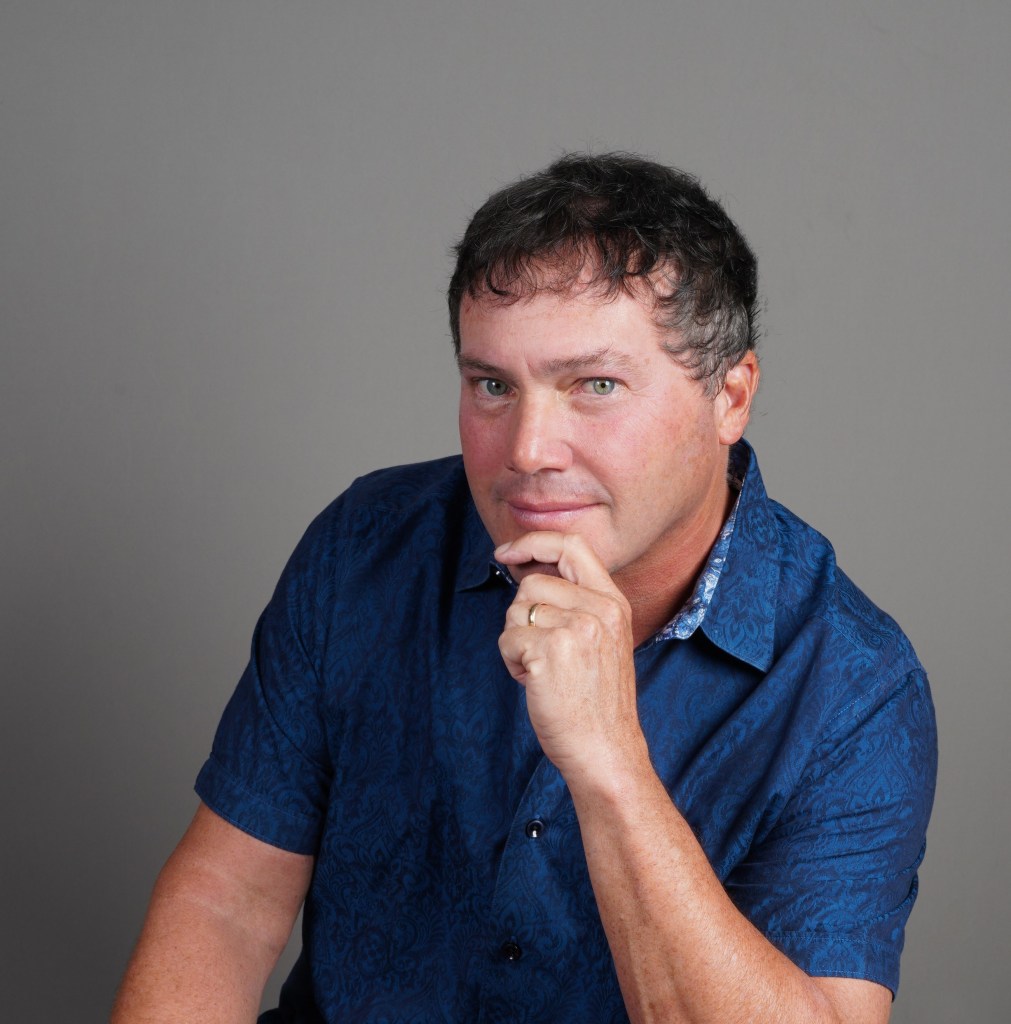
Q1. Hello, can you please introduce yourself? Readers would love to know more about you.
A1. The first line of my thriller is, “I’ll remember the day I died for the rest of my life.”
Now, I’ve always wanted to write a novel, but my father cautioned me that I needed to get a business education first–so I spent many years in marketing, eventually running my own marketing consulting agency. The writing bug never left me, and I’m gratified I was able to finally write the book before I ended up in that first sentence.
I grew up in New York and also lived many years in Westport, Connecticut. I love boating, tennis, and travel and am happy to now live in Florida where I can boat and play tennis much of the year–and travel when the hurricanes are coming!
Fun fact: My great-grandfather was brought over from Denmark by Thomas Edison to work with him in his New Jersey labs. He then actually invented, and held the patent, for plastic buttons! I proudly wear button-down shirts whenever I can.
Q2. What were the key challenges you faced while writing your book “What Goes Around”?
A2. I think the biggest challenge was learning about the editing process. While I knew some of it from my family background, I didn’t realize there were so many different types of editors. First is an editor that is more of a strategic editor, dealing with major things like structural changes. Then there’s an editor going through your manuscript line by line to make sure everything is working well. Then there is a copy editor, who checks things like dates, facts, and makes sure you didn’t say your character has green eyes in chapter 2 and blue eyes in chapter 42. Then there’s the proofreader. And the thing is, each editor at their stage wants to be the next rung up editor, so they want to show off what they can do–which makes extra work for the writer! (Of course, I did have great editors throughout–I love you all!)
And the challenge is that at each of those stages I have to read the entire book. Finally I thought I was done. Then the publisher tells me the hardcover has been typeset, and I have to read it again to make sure something strange didn’t happen during that process. I can’t tell you how many times I read my book–it’s a good thing I like it!
And the strange thing is, no matter how many times I’ve read my book, I still get surprised at the twists!
Q3. What books or authors have most influenced your own writing?
A3. Early on I read a lot of thrillers because I got them for free. My stepfather was a literary agent, so there were shelves full of his client’s books available for the taking (don’t tell his clients). I loved Dean Koontz, but alas, he was the client that got away after my stepfather had sold his first few books. I also really liked Robert Ludlum (many people know him today by the Bourne movies with Matt Damon). There were two things I really remember about him. One is that he had us over to his winter home in St. Thomas, which was on top of a hill and had an area open to the sky over his pool in the living room. I’m not sure what he did when it rained. But what I vividly remember is waking up early and seeing him on the living room couch writing with a number two pencil on yellow legal pads. Yup, that’s how he wrote his 400+ page novels. While I admire his plotting and prose, I didn’t want to emulate his long-hand writing, so thankfully I had a PC to write my novel!
The second thing is that I learned about perseverance. His first novel was shown by his agent, my stepfather, Henry, to 13 different publishers. 13 rejections. The 14th bought it, and it became a bestseller, as did all of his novels. So I wasn’t necessarily discouraged when my debut thriller wasn’t immediately bought. Interestingly, my stepfather became ill while I was finishing up my novel, and eventually died. The day after he passed on, my novel was sold. So I think there was a little help from above. Thank you Henry.
Q4. What’s your favourite spot to visit in your own country? And what makes it so special to you?
A4. I love Italy, and we like to escape the Florida summer heat and go to Lake Garda, where I can write overlooking the water. In the U.S. we have been to so many great places. But I’d have to say, Connecticut, where I used to live, would be the spot. Having gorgeous leaves in the Fall and going apple picking, making snowmen with my kids in the winter, and having summers without “feels like” temperatures of 105 was quite nice.
Q5. What inspired you to write the book ‘What Goes Around’?
A5. I was inspired to write it by what my mother said to me when I was 2 seconds old. Or so I’m told. She said, “Oh! Nice to see you, again! Well, it was that “Again” part that always stuck with me, and all my life I wanted to write something that related to it. And hence, my thriller was born.
My mother had also inspired me when I was young, as she was an editor at some publishing firms back in the day. I distinctly remember her on Saturday mornings sitting cross legged on her bed, manuscript pages strewn about her, red pen in hand. Seeing all those red marks on the manuscript pages prepared me for when I got the editorial remarks on What Goes Around from my editor. While they weren’t in red ink, the comments in the margin of the word document were just as tough. But at least I wasn’t surprised!
Q6. How long did it take you to write your book ‘What Goes Around’?
A6. All my life. The one good thing that came out of the Covid Pandemic for me was What Goes Around. I always wanted to write, coming from a background of books and authors, but took a detour into the business world. A quick digression: I got my MBA from NYU and my thesis combined my new love of marketing with my love of books, as the topic was “Marketing in the Publishing Industry.” It was actually excerpted in the industry’s trade journal, “Publisher’s Weekly”. So I actually got paid for my thesis! That was the first time I got paid for writing–I like that!
But what was even more fun was that for the thesis I had to interview executives in the publishing industry. One time I was interviewing Michael Korda, then the editor-in-chief for Simon & Schuster. He kept me waiting for quite some time, but then his door opened, and who walked out but Truman Capote! In Cold Blood-talk about a thriller! It was great meeting him.
But right, back to your original question. While it all started the day I was born with “Nice to see you again,” it took me about two years to write What Goes Around, which includes developing the story, doing the research, then the actual writing. There are two types of writers, pantsers, and plotters. Pantsers literally write by the seat of their pants. They sit down, start writing, and whatever happens, happens. Not me. I have to do the ideation, know where my story is going, so I have to do the plotting in some detail. I do an outline, include the red herrings, include the twists and turns, and then I’m ready. But not to write–then comes the research. I’ll use Google, now Chat GPT as well, but the real good info comes from talking face to face with the people who get the job done–the FBI, the detectives, the police. Now, I don’t think I spoke to any serial killers…
Q7. On what platforms can readers buy your books?
A7. My book is available everywhere. You can get the hardcover, ebook or audiobook at Amazon and other online retailers, you can get it at Barnes & Noble brick & mortar retail stores, and it’s also available at many independent bookstores.
My agent has also sold foreign language rights thus far in Japanese, Italian, and Hungarian, so soon you’ll be able to get it around the world!
Q8. Tell us about the process of coming up with the book cover and the title ‘What Goes Around’?
A8. The title of the book was originally “The Perennial Plan,” but my publisher thought we could do better. We bounced a few names back and forth, but the publisher came up with “What Goes Around,” and I love it! I love that it does tie in so directly to the storyline–especially the ending, and I love that I believe it is very interactive with the consumer. As soon as the potential book buyer sees it, they automatically say in their mind “Comes Around,” and thus I’ve already established a connection with my reader, which is also a good thing. And lastly, I think it immediately begs the thriller question of what happened that someone in the book needed retribution, and how does that occur.
The book cover was entirely to the credit of my publisher. When I worked in marketing and advertising I would usually be shown many different options of things, whether it be a new product package design, or new advertisement. I would have much to choose from prior to making my decision. Here, the publisher showed me the one cover, and I immediately loved it.
The colors of the cover shout thriller. The circular graphic alludes to a thematic element. And of course, having the bestselling author J.D. Barker’s quote on top–”Relentless and gritty, Wendroff expertly weaves a narrative that begs, ‘just one more page…” was the proverbial icing on the cake!
Q9. When writing a book how do you keep things fresh, for both your readers and also yourself?
A9. I keep things fresh based on the process I use. I’m generally best in the mornings, and will write from 8 am to 1 pm. The first thing I do is just get the words out, don’t worry about anything, just get the story flowing. Then the next day I will go back and edit what I wrote. Try to make it real writing. Make sure each word works with the other words in the sentence. Make sure each sentence works with the other sentences in the paragraph. Add the metaphors. Add the analogies. All that stuff.
After I do that, I scribble away again on my PC, just get the words out and keep the story going, which will be edited the next morning. And so the cycle continues, every day that process is repeated. Until finally, finally, I can write “The End.”
Q10. What is the most valuable piece of advice you’ve been given about writing?
A10. Never give up. Believe in yourself. And write every day (well, almost every day).
Buy What Goes Around on Amazon




 Sassy Reviews