
Q1. Hello, can you please introduce yourself? Readers would love to know more about you.
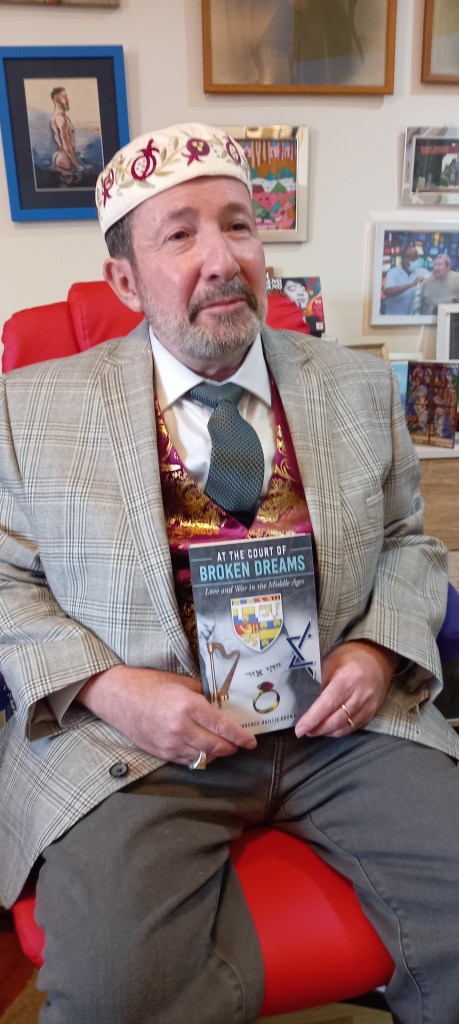
I’m Laurence, now in my sixties, born in Hull in the North of England, and – key facts – I’m both Jewish and gay, 2 attributes that don’t always sit easily together! I spent nearly 40 years teaching English Law, but my great passions have always been writing (both fiction and poetry) and music (especially playing classical piano.) In the 80s and 90s I was very active writing for the gay press in London (where I have lived for many years.) I published my first novel ‘Addictions’ back in 2000 (Gay Men’s Press.) I’ve had two 10-year relationships with male partners in my life, but now I’m happily single.
Q2. What were the key challenges you faced while writing your book “At the Court of Broken Dreams”?
I’ve been fascinated by history – and historical novels – since I was a child, but my focus was always the Tudors and Stuarts (and the ancient Greeks!). When the skeleton of Richard III was discovered – mysteriously – under a Leicester car-park, I became intrigued by the story and by the King’s hotly disputed character. At the same time I remembered the De-la-Poles – Hull’s most famous medieval family – who rose from local vintners to Royal Dukes in just 3 generations. I also wanted to write a story about a love – romantic love – between men, in a historical period when there was no concept of being ‘gay’ or even ‘homosexual’. For these reasons I have deliberately left open the issue as to whether the two ‘bromances’ my narrator Eddie has in the book are sexually realized – because in the end that’s not the most important thing. The biggest challenges were: to research the Wars of the Roses period (which took about 3 years); to use language – including some medieval English – which would not sound anachronistic; and, most important, to wear all this lightly and write a readable and I hope gripping – and moving – story.
Q3. What books or authors have most influenced your own writing?
In writing this book I fell back on my favourite historical novelists: Robert Graves (‘I, Claudius’); Gore Vidal (the brilliant ‘Narratives of Empire’ series); and the spell-binding but largely forgotten Mary Renault, who wrote wonderful novels set in classical Greece (e.g. ‘The Bull from the Sea’). I also adore England’s 2 greatest novelists: Jane Austen (‘Persuasion’ etc) and George Eliot (the brilliant ‘Daniel Deronda’ which deserves constant re-reading.) I wouldn’t presume to say they have influenced me.
Q4. What’s your favourite spot to visit in your own country? And what makes it so special to you?
This is difficult to answer, as I’m much more historically than geographically inclined. Hull is still important to me, but mainly in my imagination. My favourite English city is probably Brighton, a colourful, historic resort on the south coast, which has the sea (I miss that), the fantastical Royal Pavilion (built by the Prince Regent) – and a brilliant gay life!
Q5. What inspired you to write the book ‘At the Court of Broken Dreams’?
Trying not to repeat myself, it was the confluence of my passion for historical fiction, the extraordinary discovery of King Richard III’s bones, my fascination with the fifteenth century (important to me because that was when my alma mater King’s College, Cambridge was founded by the tragic King Henry VI, who also appears in the book), my desire to write a ‘real’ love story between men, and, I should add, my fascination with the ambivalent status of the Jewish faith and community in the late Middle Ages.
Q6. How long did it take you to write your book ‘At the Court of Broken Dreams’?
As I remember, about 3 years for the research, followed by about one year’s writing. At that point – half way through the story – I had some sort of mental and physical breakdown, which unsurprisingly held things up for about 3 years! Then, as a part of my recovery, I began reading – and writing. It took about another year to complete and revise the novel. I finished it in the Spring of 2022 and, having had some bad experiences with publishers, decided to publish independently. Which is brilliant in terms of choosing one’s own cover-art etc but is also deeply frustrating e.g. the mainstream press clearly believe all independently published novels are crap as they won’t even look at one before refusing to review it. Talk about narrow-minded. As a result of that, I would prefer to have a major publisher for my next novel…if I write one!
Q7. On what platforms can readers buy your books?
My novels – there are now 3 out there – are all available from Amazon, Waterstones, Barnes and Noble and quite a range of independent bookshops (which delights me.)
Q8. Tell us about the process of coming up with the book cover and the title ‘At the Court of Broken Dreams’?
I simply don’t know where the title came from, but I had it from the first concept and it never changed. It also has a ‘sub-title’: ‘Love and War in the Middle Ages’ which is probably more informative.
The covers are a combination of key images in the story, which I chose: the male torso with Hebrew text ‘written on the body’ (it reads ‘Let there be light’); the harp, which is Eddie’s instrument; his ruby ring; and at the top, the authentic coat of arms of the Earls of Suffolk, Eddie’s ancestors.
Q9. When writing a book how do you keep things fresh, for both your readers and also yourself?
In writing this book I can assure you I had no need to keep it fresh as I was totally driven, from beginning to end. I was utterly fascinated by the characters, who, after a while, began to tell their own stories.
Q10. What is the most valuable piece of advice you’ve been given about writing?
On writing historical fiction, I was given the excellent advice not to wait to start writing until you’ve finished your research – because you never will.
On writing generally: I think it’s from ‘Aspects of the novel ‘ by the wonderful E.M. Forster (‘Passage to India’) who said something like: say just what you want to say, as clearly as possible, then stop. And also that the most important quality in any novel is the “and then…and then” quality. The man was a genius. Sadly he died just about a year before I went up to King’s College Cambridge, where he had been a life Fellow.
Buy At the Court of Broken Dreams on Amazon
 Sassy Reviews