
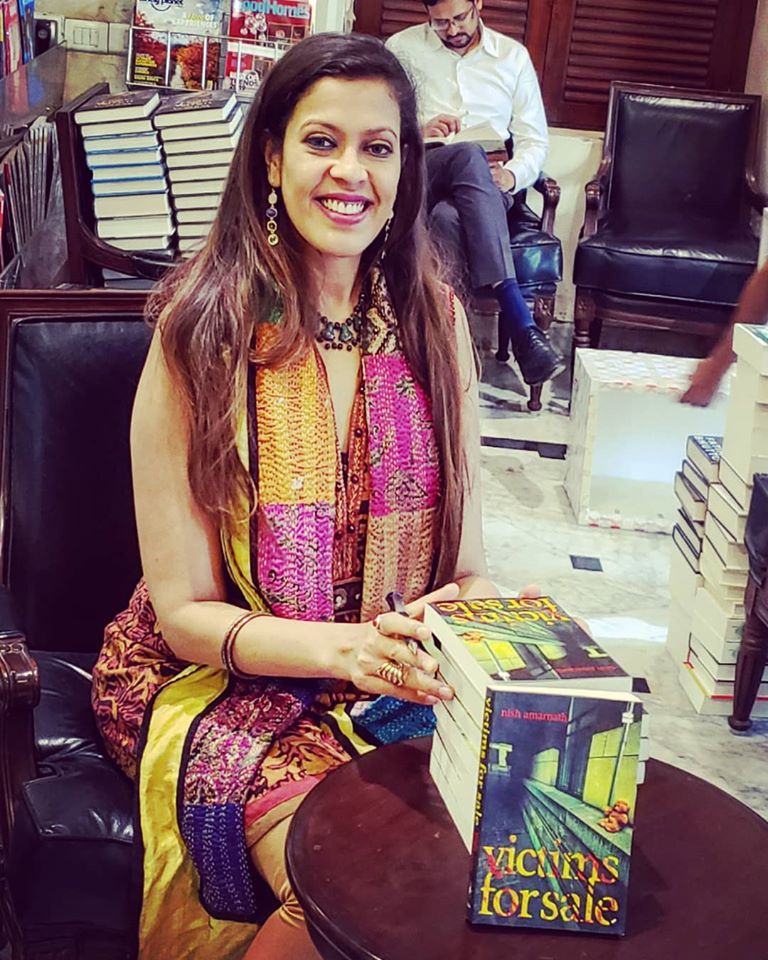
Nish Amarnath is a New York-based journalist, author and poet whose latest book, Victims for Sale has enabled her to share her voice on various social, cultural and human rights issues at many platforms including U.S. State Department affiliates and United Nations associations. Nish has worked under the guidance of Writers House NYC founder and literary agent Al Zuckerman who groomed and launched various novelists ranging from Ken Follett to Nora Roberts. Nish was contributing editor at the Big Thrill Magazine, where she profiled other prominent novelists like Christina Dodd. She holds a full-time editorial post in New York and is additionally a part-time faculty member at the New York Writers Workshop. She was previously managing editor of one of Europe’s most prolific magazine publishing groups. Her writings have appeared in the Wall Street Journal, Medium, the Washington, D.C.-based literary journal, Del Sol Review, the Radical Humanist, The Thrill Begins Magazine, BookTrib, Yahoo!, TheStreet.com and India Today, among others. Her website is www.nishamarnath.com
About Victims for Sale
Victims for Sale, couched as a psychological thriller and crime suspense novel set in London, delves into the sexual and reproductive rights of mentally challenged women in a milieu fraught with conceptions of family honor among South Asian communities worldwide. The book, published by HarperCollins to considerable success in India, was nominated for the Mumbai Film Festival Word-to-Screen Award. Outside India, it has been endorsed by literary figureheads like British author Adam Hamdy, American mystery writer John Dobbyn, and Shamus Award-nominated author Charles Salzberg who described it as “reminiscent of the prose of Megan Abbott.” You can learn more about Victims for Sale here
Nish speaks about Victims for Sale, her publishing journey, mental health, and more.
1. If your novel were to come true, would your decisions match those of Sandy, or would you make a different choice?
Nish: Perhaps, I wouldn’t have fallen for the trap and would have decided my response differently, because Sandy is probably far more naïve than I am. That said, it’s hard to say! That’s because I, as an author, had control over Sandy’s circumstances and the reality of the situation she was unraveling, as also the outcomes of her decisions. We do not have a similar control over our own reality, in terms of matters of life and death as well as decision-related outcomes that tend to depend on the situations, preferences, whims and psyches of countless other people. The only aspect where we do have control lies is our attitude. But, more broadly speaking, yes – I do believe in justice, respect, and love. So, I would certainly stand up for people who are treated unfairly, discriminated against, defenseless to stand up for themselves, and/or unable to access the resources they need to function effectively. I also do not believe in categorizing people, based on their emotions, capabilities, skill sets, gender, sexual orientation, race, geography, etc.
2. What was your favorite moment in the entire journey of publishing Victims for Sale?
Nish: Victims for Sale grew out of my fieldwork as a journalist. Research for this book included site surveys at many crucial locations in London and interviews with at least 50 subjects across London, Mumbai and New York. One of my most favorite moments was my interview with former Metropolitan Police Service officer, Jackie Malton who’s a UK TV script consultant and a muse for the character of Jane Tennyson in the British drama series, Prime Suspect. Jackie actually mapped out a blueprint delineating various possible outcomes of varying permutations and combinations of options for many scenes that involved police procedural elements. It was one of the most enthralling conversations, by far, and her insights helped make aspects of my scenes more authentic and intriguing. Another favorite occasion is a musical video I did for the book once I signed with my literary agent. This video, shot in London and New York, features a trailer-like narrative sequence against the backdrop of song called Fallen Angels, which I’d composed, written, sung and recorded. Fallen Angels became Victims for Sale’s theme song through this video. The entire creative process behind it was fun!
3. For your upcoming novels, would you be interested in exploring a different genre, or staying in the same genre? Why?
Nish: For me, genre is secondary. My approach to storytelling is one of exploring varying degrees of inner and/or outer conflict. So, I believe that the story has to be told well and the genre that does the story most justice is the one that’ll stick. Victims for Sale started out as a literary thriller when I began writing it. It evolved into a plot-driven psychological thriller, which is how my literary agent pitched it. And ultimately, HarperCollins couched it as a crime thriller and suspense novel. My upcoming novel is a character-driven romantic drama infused with literary overtones and strands of magical realism. It can fall in the ambit of upmarket fiction, commercial fiction, romance, women’s fiction and/or magical realism. Other future titles brewing in the alcoves, include a financial thriller, an adult fantasy, a romantic suspense novel and a social satire. So, I certainly hope to write across genres, because emotional voltage is what I do best as a writer. There has been a growing market for mixed and blended genre novels in recent times, and I see this as a trend that can encourage more quality fiction.
4. What is a crucial tip of advice you’d like to give to authors who are yet to start with the publishing process?
Nish : Be intellectually curious, read voraciously, and practice not only writing, but also storytelling in any form across multiple genres, formats and media. These help you find your voice. And voice is a huge component of how agents, editors, readers and audiences relate to one’s work as a writer. Further, have a realistic sense of what you can and can’t do, and have faith in yourself and your work. Publishing is a slow and subjective business that mostly abounds with rejections, ghosting, restructurings and other unexpected developments that can set authors back if they do not have connections in high places or the backing of a powerful celebrity. That said, there’s always room for true talent. So, rest assured that the work you’ve done with honesty from the depths of your heart and soul, will find a way sooner or later. True talent cannot be hidden forever.
5. What were your favorite reads as a teenager?
Nish: I read different authors and genres. In my tweens, it was Sweet Valley High and Sweet Valley University! In my teens, some of the books that I especially loved were Danielle Steele’s The Long Road Home, Rage of the Angels by Sidney Sheldon, King of Torts by John Grisham, Jeffrey Archer’s Kane and Abel, Erich Segal’s Prizes, Robin Cook’s Invasion and Flora Schrieber’s Sybil. In terms of classics, I enjoyed Charles Dickens’ A Tale of Two Cities, Thomas Hardy’s Tess of the d’Urberville, and A Flower in Season by Audrey Howard.
6. What’s your take on the talk about mental health these days? Do you think it has reached a point where mental health concerns have been normalized?
Nish: The root cause of poor mental health today is our failure to accept ourselves, and one another, for who we are. Right from TV ads dishing out weight loss products and skin fairness creams to YouTube videos that claim to teach how you can get your ex back, we’re made to feel inadequate. Commoditization of people is the main reason for this problem.
Women contend with various social, cultural, religious and familial expectations as an offshoot of patriarchal constructs. Likewise, men have been conditioned to rein in their emotions and refrain from expressing themselves or showing any sign of vulnerability. Combine this backdrop with today’s growing ethos of impersonal interactions with bots and other forms of technology, not only to resolve a simple problem like a phone not booting up, but also for more serious and pressing concerns such as a health emergency. Unsurprisingly, in the last 30 years, the incidence of depression has increased by about 53.5% globally to 264 million people worldwide in 2020, according to the World Health Organization, compared to 172 million in 1990, according to a Global Burden on Disease study that appeared in the Journal of Psychiatric Research. Nearly 1 million people die by suicide every year. The WHO lists depression and anxiety as among the top ten causes of serious illness and/or disability among young people. Human beings are intrinsically compassionate and caring creatures driven by love and bonding at the core, so I think many systems and practices are counter-productive and counter-intuitive to our natural state of being. Such systems and practices include communicating only through social media, text, IM or email rather than through phone and face-to-face interactions, soaring drug prices, lack of access to proper medical care without a good health insurance, the need for instant gratification and success without much patience or effort, and at-will employment clauses, which are the norm in the U.S., meaning companies can fire you at will, with or without any cause of notice.
7. What can we do to improve the current mental health scenario?
Nish: I would suggest starting with simple things. This includes finding some ‘me’ time, so that we can give back to ourselves the energy we put out in the world. Empathy can go a long way in boosting mental health, both individually and collectively. Being non-judgmental is helpful. In the current pandemic, this could be something as simple as not yelling at a stranger who requests for room to pass by an aisle in a crowded supermarket, not barging into an elevator without wearing a mask, especially when a person inside is trying to step out. You don’t know what this person is grappling with. This person could have cancer or other pre-existing conditions that make him/her more susceptible to contracting the virus. We never know what someone else is going through. So, let’s not criticize others unless we want to provide feedback that will help them improve. Let’s be kind to strangers and friends alike, or at least civil. Let’s truly listen to people, rather than treating one another like robots or money machines. Let’s choose to trust one another a lot more. Let’s share more. Let’s laugh more often. Let’s not categorize ourselves and others, based on race, gender, body size, financial status, or millions of other factors. Let’s not compare ourselves with others. Let’s drop out of the cog-in-the-wheel rat-race and make time for those we care about. Let’s appreciate and try to see the good in others. Let us let go of the illusion of “normalcy.” Let’s simplify our lives, All of this can go a long way in strengthening your own emotional health and that of the society, at large.
You can buy Victims for Sale at bit.ly/VictimsForSale
If you’d like to be learn more about her next novel, Twin Flame, you can be part of her newsletter by signing up at www.nishamarnath.com/twinflamenovel
Connect with Nish Amarnath:
FB: https://www.facebook.com/nishamarnath/
Instagram: @themillennialchick
Twitter: @nishamarnath
Website: www.nishamarnath.com
 Sassy Reviews