
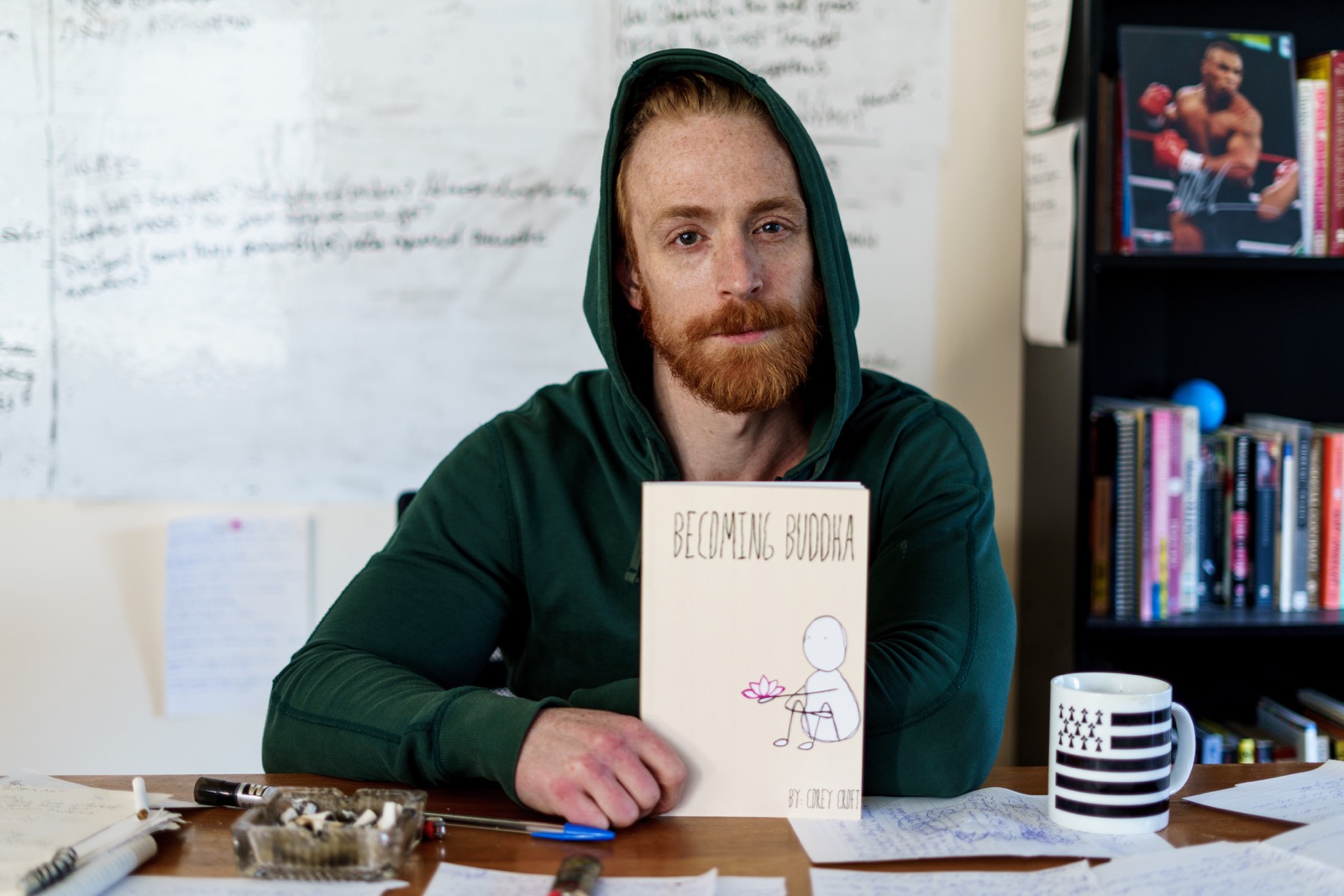
Q1. Hello Sir, can you please introduce yourself? Readers would love to know more about you.
My name is Corey Croft, I live in Vancouver, Canada. Besides story-telling I enjoy exercise and travel. It should be important to differentiate travel with vacation, or as the Brits call it ‘holiday.’ Everyone loves not working and spending leisure time in varying degrees of luxury and pomp. Not working is most people’s idea of a great time, even if it is just staying at home and watching movies on the couch or staring idly at a plain wall. When many people say they enjoy travelling, they really mean they enjoy merely not working and adding a tropical destination to the pot for spice. Yeah, that rant more-or-less sums me up.
Q2. What were the key challenges you faced while writing ‘Becoming Buddha’ book?
Buddha was a shock to the system because it was both the first book I had ever written and the first attempt that I had ever taken to write something that wasn’t purposely built for academia. It was a good instructor in regimentation and discipline. It proved a greater influence in what ended up becoming a borderline-obsessive necessity from then-on. I hadn’t formulated a strategy or a blueprint beyond some primal urge to write. It turned out there was more in my head than I’d thought and it just kept coming, and coming, and… When the first draft was completed, the whale weighed-in at more than 200,000 words. Even crazier, I roped in a few poor souls to read it. The biggest obstacles to overcome were all those that amateurs and first-timers encounter: doubt, fear of failure, the overwhelming feeling of putting a tempest into a tea-cup, and more.
Q3. What books or authors have most influenced your own writing?
The big two have been Dostoevsky and Kafka. The Russian’s Crime and Punishment was written in a way that seemed to pierce directly into the centre of my heart and I was able to relate entirely. The same goes with the latter’s works, who also added a sense of absurdity that opened a door to my mind which has stayed ajar. Some others, for reasons of eloquence, creativity prose, or narrative have been Nathaniel West, Philip K. Dick, Hunter S., Gogol and many more.
Q4. What’s your favourite spot to visit in your own country? And what makes it so special to you?
My country is enormous. I live on the west coast, which has mountains and ocean and is visually stunning as well as yields a very agreeable climate in comparison to the rest of the country. I like the Eastern Maritime provinces, the Islands off the coast of my province and Toronto. My favourite place is Montreal. It is in the francophone province of Quebec and is quite unique for that and other cultural reasons. I lived there for a spell and look forward to returning when the pandemic loosens its jaw.
Q5. Is there lots to do before you drive in and start writing a book?
Depends on the story. For a shorter story, especially one of my more absurd pieces, I dive in with a loose metaphor and let it unravel. I don’t hold back, anything. It feels good. It can be confusing and overly convoluted, but, that’s half the fun of the dissection. For a standalone novel, I tend to map it out as much as it needs. Most importantly, I want to know the character bases very intimately and develop theme and plot points. Oftentimes, I do this through key events and interactions. I use the characters as a means to have conversations with myself; they usually take far ends of the spectrum and speak towards the middle. As a result, I have to plan out the dialogue. Not in the sense of actual script, but what the characters represent to the story and theme and what they ultimately stand for in the larger scope. I could go on for too long about this, so, let’s just say that planning is important and varies depending on the message and its profundity.
Q6. How long did it take you to write ‘Becoming Buddha’ book?
Buddha took, if I recall, 6-9 months to write a rough draft. I realize that three months is decent-sized gap, however it was a while ago. It really came together at a certain point, somewhere around midway through part 2. The long part was the editing process and my own confidence behind the project. It was long and personal. I knew that it had some very touchy subject matters and needed someone that I could trust. The editing and evisceration of that beast took a while. During the edit, I damn-near rewrote the entire thing, top-to-bottom. There was a point when I ‘got it.’ More than the nakedness of the piece, I knew what it meant, why it was important, and, with some help from Bukowski and his vulgar prose, I was comfortable in letting my true voice ring-out.
Q7. On what all platforms readers can find ‘Becoming Buddha’ book to buy?
Buddha is available through Amazon and its long-ass arms on print and e-book. It is also available through Ingram Spark and their sellers, but I am unsure if it is solely e-book or if some representatives have a print-on-demand service as well. In reality, if you don’t have the money or the ability to utilize one of the outlets, holler at me and I’ll email a copy. I just want my books read and enjoyed.
Q8. Tell us about the process of coming up with the book cover and the title ‘Becoming Buddha’?
The original title, which I won’t say for the same reason I didn’t go with it, is a dead giveaway and spoiler for the last two parts of the book. The actual title came to me while I was listening to a song. I’d heard it a while before I’d written the book and then heard it again as I was writing it. I remembered the effect the lyrics (which are also used for the epigraph) and changed them around. The cover, done by my brother Spencer, was an idea that I had when putting everything together. I think it all fits perfectly, even if people seem to read the book as one or both a self-help book and memoir. Truthfully, I don’t know what it is beyond a story.
Q9. When writing a book how do you keep things fresh, for both your readers and also yourself?
I have a stellar bull-shit/anti-corny meter. One of my mutant abilities is to rebel against commonplace trends and make my weird whatevers seem cool. I jest, but I don’t. If something is significant enough to impress me, it has already passed through several layers of tough security. There is no one maneuver to keep things fresh. Recognizing gaps of what is not being done and doing the opposite are good yardsticks, and my brain does this reflexively. What is most important is that I (or you) make something your own. Show respect to the story and characters but keep them in a wound fist.
Q10. Are there any secrets from the book (that aren’t in the blurb), you can share with your readers?
That’s too vast of a question to answer. All of my writings, everything I do is saturated with hidden meaning and lade with Easter eggs. It’s one of the ways I keep it fresh and hope to make potent connections with my readers. Some of the things are for my own amusement. Some are near-microscopic details in descriptions or locations or characters that have been picked up and brought back to my attention. While a story can entertain, educate, enlighten or any number of words that start with E, a link is forged between the author and the reader through the strength of the connective tissue and what is being said and how. That is woven in the style and the descriptive minutiae of the story and is akin to idiosyncrasies in a relationship. We may have jobs and interests in common but it’s how we jive and get-on that really makes or breaks our future together.
Book Is Available On Amazon
 Sassy Reviews