Q1. Hello, can you please introduce yourself? Readers would love to know more about you.
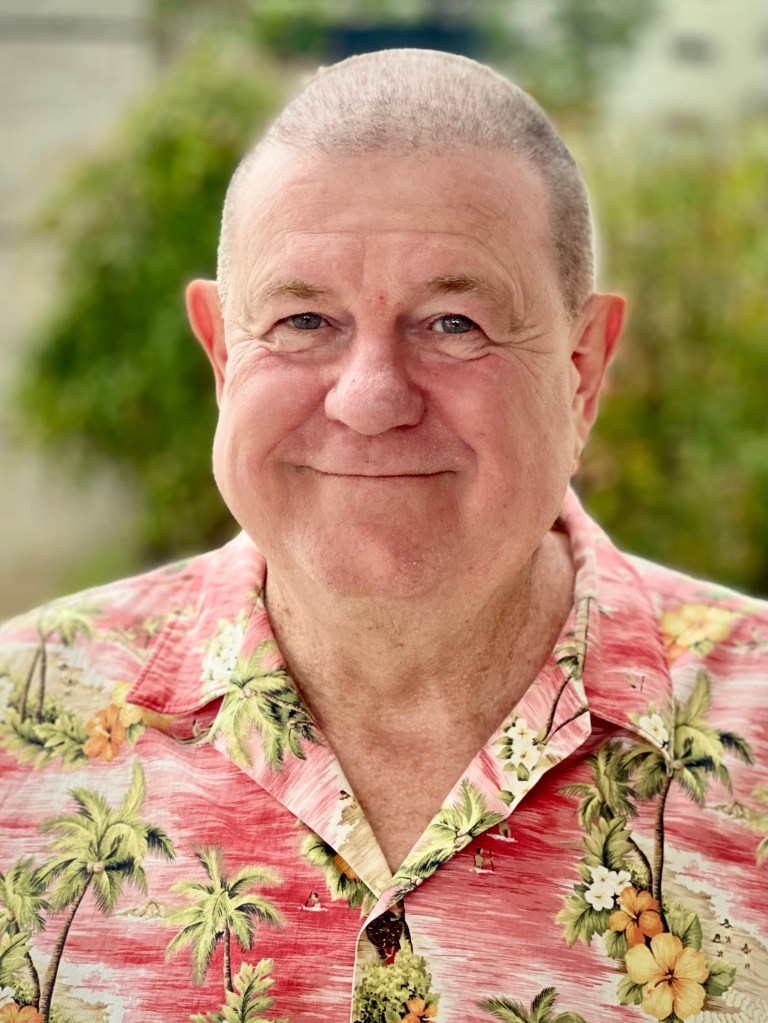
A1. That is a tall order. You see, I’m old. I’ve been around for a while now and have at least once completely circumnavigated this amazing globe we all share … though I found that this sharing is divvied out in somewhat unequal proportions.
From my Amazon Writer’s page:
“Born in Columbus, Ohio, my spark for writing was lit while attending Reynoldsburg High School. Being severely dyslexic — a condition my teachers had apparently never heard of at the time — I could barely read and could almost write by the time I was eight years old. I had to knuckle down and teach myself how to get into those things called books. At the age of 14, I even copied an entire novel on my Remington typewriter, trying to get a feel for the author’s charismatic lure. It was one of the “Lucky Starr” young-adult sci-fi adventure stories by Paul French (aka the legendary Isaac Asimov). While attending high school, I fell in love with — of all things — English 101, though my mental condition continues to confound me to this day (thank you, spellcheck).”
After high school, I stepped into a pair of Army boots, met my unexpected wife-to-be in beautiful Panama, and we toured this world of ours for 14 beautiful years with three equally impressive sons. Following Desert Storm, my wife gave me the ultimate ultimatum, and I had to leave military service. If the choice was between her and anything else on the planet, she got what she wanted. That was inevitable. Having had enough of packing and unpacking, shipping and flying and walking and driving and roaming, she wanted a permanent home, so… Well, taking up various technical occupations, I found time between working and sleeping to write another paragraph, a chapter or two. After 30 years together, my lovely wife passed away, and here do I sit, still pounding out these confounding stories.”
My usual genre is science-fiction, where I feel most at home, and always an adventure, a sure boon for readers, young and old. From Alpha Centauri A to Vega, from Andromeda to the Whirlpool Galaxy, across dimensions and universes, to all stars and countless worlds between. Let go and fly, my friend, for surely an adventure awaits, ‘second star to the right, and straight on ‘til morning.’ ”
Enjoy the written word, for nowhere else will you find such a variety of intrigue and adventure, love and hate, peace and turmoil, worry and relief, all in light-weight pages to fill the evening hours and lull you to a dream-filled sleep. I have been a warrior and a technician, a leader and a follower, a hater and a lover. As for my dyslexia, it remains here with me; still a bane, yet my current experiences include lauded publications, both creative and technical. My creative writing is generally science-fiction, now with three exciting publications available to you. My technical writing encompasses both military and civilian worlds, with hundreds of highly detailed documents.”
The details — it is there where my little demons thrive.”
Q2. What were the key challenges you faced while writing your book “Mit-Ro-Don: 1974”?
A2. Well, youth more than anything else. I started puttering around with it in high school, then shelved it and joined the US Army Infantry. I had a break in service three years later and looked over that manuscript. In all seriousness, It looked like it had been written by a child … and it had. After a year and a half of Army Reserve, I returned to Active Duty … they called me a ‘retread soldier.’ Fully 7 years Infantry, 7 years Signal, and Supply Clerk for my 1.5 years break to Reserve Duty. I finally departed military service in 1992 and dug deep into the “Mit-Ro-Don” story, eventually self-publishing it in 2000. The reworked manuscript is now getting set for a revised re-release, hopefully before Christmas.
Q3. What books or authors have most influenced your own writing?
A3. Well, I’m highly dyslexic, so motion pictures more than books, such as:
Stanley Kubrick’s and Sir Arthur C. Clarke’s “2001: A Space Odyssey” (1968)
Harry Kleiner’s, Jerome Bixby’s, and Otto Klement’s “Fantastic Voyage” (1966)
“Bantam Books obtained the rights for a paperback novelization based on the screenplay (for ‘Fantastic Voyage’) and approached Isaac Asimov to write it. Because the novelization was released six months before the film, many people mistakenly believed that the film was based on Asimov’s book.” Yeah … people like me….
— Wikipedia
Irwin Allen’s and Charles Bennett’s “Voyage to the Bottom of the Sea” (1961)
H. G. “Herbert George” Wells’ “The Time Machine” (1960) and “The War of the Worlds” (1953)
Jules Verne’s “Around the World in 80 Days” (1956) and “20,000 Leagues Under the Sea” (1954)
William Shakespeare’s “A Midsummer’s Night Dream” (1935)
Thor Heyerdahl’s “Kon-Tiki”
I was drawn to read the books these films came from, which led me further through Edgar Rice Burrows’ books with the “John Carter of Mars” series and the “Tarzan” books, Isaac Azimov’s “Lucky Starr” series, “Foundation and Empire,” this sci-fi master’s comedic short story “Pâté de Foie Gras,” and of course Sir ACC’s “Rendezvous with Rama.” I got into a lot of Shakespeare, which drew me into the epic poetries of Greek classical plays and poems; “Odysseus,” “Argonauticus,” “Oedipus Rex,” and the like. In my youth, “The Adventures of Robin Hood” and Thor Heyerdahl’s book “The Kon Tiki Expedition” took me over, and the “12 Labors of Hercules” held me tight to those three marvelous books by Thomas Bulfinch:
“The Age of Fable” (1855)
“The Age of Chivalry” (1858)
“Legends of Charlemagne” (1863)
Of course there were also the old “Tom Swift,” “Brains Benton,” and the “Rick Brant” young reader adventure series of books … and comics of all sorts….
Your next adventure begins with that first step into your future.
Q4. What’s your favourite spot to visit in your own country? And what makes it so special to you?
A4. Any local library, the Ohio State Fair, just because it’s the Ohio State Fair (the smells, the chatter, the machines of the midway, the food, all of it). I also like going to Blacklick Woods State Park for a quiet picnic table and some serious writing. Cup-A-Joe, Panera Bread—really, any nice, quiet place (with coffee) to iron out a story or kick off some unbelievable new adventure.
I don’t think I’m very good with places, I analyze quite a lot, so I probably have a pretty good idea of wherever I happen to be. I remember disappointing my wife on a visit to the Grand Canyon. We were on our way to a military assignment at White Sands Missile Range, NM, and crossed the canyon at the narrows of Marble, spotting a few small wild horse herds along the way. From Marble Canyon, we headed west to the wider Grand and stopped for a look from the grounds of a somewhat plush hotel. It was nearing Thanksgiving Day and I told her and the kids it was getting late, but all I could think about was signing in early at Sands that evening. She said we could spend the night and leave early the next day, but all I really wanted was to get into my new work at White Sands.
“Look at it, Honey. It’s a hole in the ground. C’mon.”
Yeah … today, I’m pretty sure we should have stayed.
Q5. What inspired you to write the book “Olympus, and the House of Tchrlok”?
A5. That would have been my wife, Anita. Throughout the 1990s, Hollywood seemed of the mind to recreate all the classical mythologies to their liking—kinda like the misinterpretations that shouted down at audiences viewing Disney’s “Pocahantas”—with lame TV shows, multi-million dollar comic book flicks and the like. For some reason, my wife liked watching those portrayals, but the episodes drove me to write (angrily) at least a hundred short stories of how mythological persons and deities might actually interact with present day mere mortals … you know, you and I. Well, I caught my wife leafing through that mess of mythology one day and she told me that these needed to be published. …And, as always, what Anita wanted, Anita got.
A Book of Traxis
A Book of Earth
A Book of Gods
A Book of Khaos
At the time, I was employed as a network software guru—coworker’s word, not mine—at MCI WorldCom over in Hilliard and took the pages to work with me. At the end of my workday, I found an unoccupied boardroom and spread the sheets out, rearranging my collection of short stories into a kind of plotline. I sat and thought about them for a while, coming up with the 4-book method of arrangement, with the first two—“A Book of Aliens” and “A Book of Earth”—starting approximately 5,000 years ago. Backstory stuff. Since there really were no Greek Olympian deities from mythology—hence the term ‘mythology’—I had them created by an alien race just 100 years before the main story’s timeline, which was just after World War II, a time that coincides with when these aliens began their flight of a few thousand light years to the invasion of Earth, traveling from the Perseus Arm of our Milky Way galaxy, as well as the date of an erred radio telescope signal recorded from 1946 as a starting point.
I even included a light sprinkling of deities from other religions of the period.
Had I researched a bit further, I could have pulled the story in a little closer to current time by using OSU’s now famous “WOW!” signal of August 15, 1977, as the second contact, rather than the imagined April 24, 1996.
https://en.wikipedia.org/wiki/Wow!_signal
Once I had the basic layout for the story, I just fussed it all out into a novel. Also, I had first published this tangle of ideas online while it was being created, in a somewhat volatile place called HabitableZone.com where I got a lot of suggestions, including the idea of adding a glossary of terms and characters to help members of this nation’s population that had been brainwashed away from the old Bulfinch textbooks. The site used to be a fairly habitable place to visit for scientific reckoning…. I haven’t been there in a while—of late, it’s gone quite political. I’ve posted a few very short stories on the site’s Science Fiction page, but nothing very recently. I used to be one of the HabitableZone moderators.
Anita passed away before I could get it published, and I shelved the whole thing, spending time just moping about and feeling sorry for myself over the loss of my one, true soulmate. I had been 21 when we met in Panama, and she was in her final year of high school. She wanted nothing to do with me…
…But all of that is recounted in my dedication pages for “Olympus, and the House of Tchrlok.”
Q6. How long did it take you to write your book “Mit-Ro-Don: 1974”?
A6. I started it in 1973. Its initial publication was not until 2000. Between those dates, I sort of tinkered around with it, trying for an angle of plausibility.
Q7. On what platforms can readers buy your books?
A7. Amazon.com would have to be my first choice, if only for the tidy arrangement of the various works. The newer books should also be available at Barnes and Noble, Google Books…. A person should be able to request a copy from any major outlet store.
Q8. Tell us about the process of coming up with the book cover and the title “Olympus, and the House of Tchrlok”?
A8. The book cover was all mine. I figured I would use the Crab Nebula’s neutron star, a pulsar at the core of that bubble of star debris. It’s surrounded by a very colorful, fairly symmetrical nova and always makes for a thought-provoking picture. My Traxian Empire would be located in the Perseus Arm of the Milky Way galaxy, and the Crab Nebula is situated far below that arm and approximately 7,000 light-years out from our Solar System. In the novel, the collapsed red giant star that created the pulsar and the accompanying nebula was referred to by my Traxian historians as Tractosk Prime. |The collapse into a supernova occurred approximately 7,850 years ago, which was visually recorded by Chinese astronomers back in the year 1154.
[If you do the math it won’t exactly add up, because the measurements used are estimates.]
Overlaying the Crab Nebula (in the Taurus constellation) with the constellation of Perseus was done simply because Perseus, as a new godling, was a main character in the novel.
Seemed okay to me. I have not yet seen what my publisher’s idea for a newer cover might be, but it should be quite interesting.
Q9. When writing a book how do you keep things fresh, for both your readers and also yourself.
A9. With some bit of conflict, a thought provoking dialog, or just a stroll along a quiet, dark, likely hazardous city street….
It stays fresh because no one has read it yet. For many, my books are still a mystery.
When I was tweaking “Mit-Ro-Don,” I thought about how movies were made and I would read through a chapter slowly. If there was no new adventure in that chapter, I tossed one in and built upon it for the next chapter. I would build and build and build, until I just needed to end the war.
Q10. What is the most valuable piece of advice you’ve been given about writing?
A10. “Ah, you’ll never do it.”
That was from my older brother, Rick, a trucker who has now passed away. I miss him a lot, and I think he knew I was a determined soul. He pushed his protests almost daily, saying there was no way I could ever get published, but in 2000, I did it anyway.
From then on, Rick would introduce me as “My writer-brother Dan!”
He was proud of me—and I was proud of him.
Buy books on Amazon








 Sassy Reviews