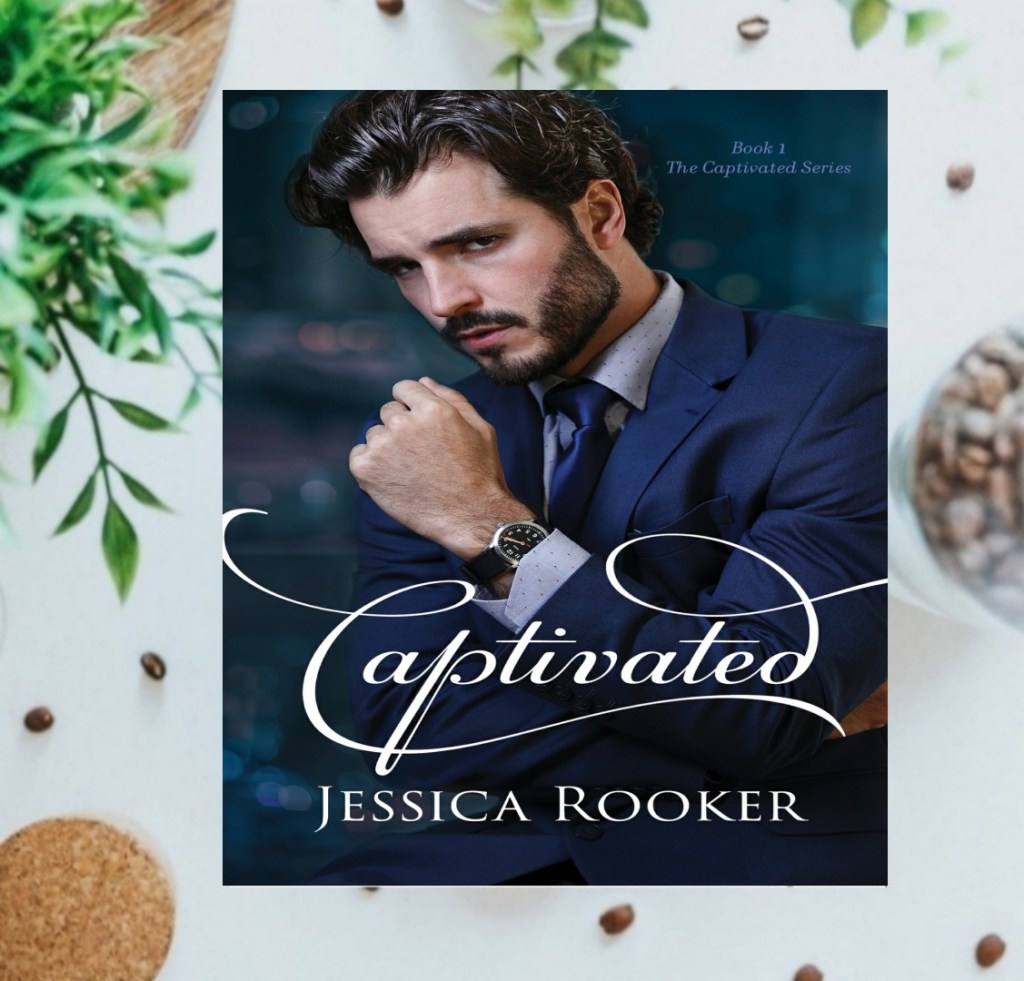
🚀 𝐑𝐞𝐯𝐢𝐞𝐰: Captivated written by the author Jessica Rooker is the first book in The Captivated Book Series. The main characters of the story are Amelia Johansson and Quinton Starks.
Amelia isn’t living in a happy marriage. Her husband is a master manipulator who abuses her. It has been ten years of marriage and Amelia has been tolerating her husband till now. Sometimes she loves imagining a different life. In that life, she married the love of her life, has a husband who adores and respects her.
One day Quinton’s assistant booked a stay at Amelia Island for Quinton. When Quinton visited there, Amelia found him sexy. For the first time in the past ten years, she felt alive. Read this book to know what happens next.
The cover photo of the book is nice and the writing style of the author is amazing. I had a great time reading this book. The plot of the story is interesting and you won’t feel like putting this book down once you start reading it. Add it to your tbr.
Q1. Hello, can you please introduce yourself? Readers would love to know more about you.
My name is Craig Weidhuner, I’m from Toronto, Canada. I’ve always been gifted with imagination since I was a child. I inherited from my father a love of science fiction and fantasy. Everything from Star Trek, to Star Wars, to Godzilla as well as comic books (just to name a few). I would often play a fantasy role as a child and I was fortunate that I never grew out of that. I’ve been writing for years, creating my own fictional worlds as a way to escape the real world. After years of working in various warehouse jobs, I began worrying about my finances and how I would support myself. One night in my dreams I saw what they call “angel numbers” telling me not to worry about my finances but to follow my dreams, or “do what you love and the money will follow”. Also around this time I read a book called “Conversations with God” and I remember one line in the book which said, “Life begins at the end of your comfort zone.” Having been held back by fear for far too long, I finally decided to take that leap and actually write Mystical Force. Ironically I originally planned it as an anime series, or even a manga. However, having limited finances, not to mention artistic (drawing) talent, I decided it was easier to start by writing a book, those adaptations may come at a later date. The advantage of spending years writing synopses of my various stories for leisure means that I already have a vast back catalogue of material from which to draw from. That’s how I write so prolifically. I’ve written basic plot synopses (like the kind you’d find by looking up a book or movie on Wikipedia), so I just take those and modify/expand them into a full fledged manuscript.
Q2. What were the key challenges you faced while writing your book “Mystical Force: Vol. 1 Stranger in a Strange Land”?
Having never written a novella before, I was in unfamiliar waters. The hardest part was letting go of my ego when I first got back the notes from my editor. As the author, I know why my characters think and do what they do but you as the reader don’t. Thus when I get notes back asking me to better explain things/actions or pointing out basic plot holes/inconsistencies (“Why does Bob have blond hair and blue eyes in chapter 1 but dark hair and brown eyes in chapter 3?” for example). As such I had to remind myself this wasn’t criticism of my writing but my editor helping to make my story the best it was. Now I am extremely grateful for my editor Tereza who has done a fabulous job of turning my work from a rough manuscript into the book you’re enjoying right now. In fact, when I got back my notes for Mystical Force Vol.5: Shadows and Darkness, she said she was becoming emotionally invested in these characters. What greater compliment could an author receive that that?
Q3. What books or authors have most influenced your own writing?
Honestly, it’s not so much other books or authors that have influenced my writing but more movies and television. My two biggest inspirations were:
Shinichi Sekizawa, screenwriter of many of the classic Godzilla movies (such as my personal favourite “Mothra vs. Godzilla”) for the way he turned the Toho kaiju (giant monster) genre into a genre of its own. I like the fact that he made the monsters flesh and blood characters rather than the typical plot devices/obstacles for the human characters to defeat. As someone once said “In monster movies, monsters threaten people and people resolve the problem. In Toho monster movies, people threaten people and monsters resolve the problem.” I also love how in the movies “Mothra”, “King Kong vs. Godzilla” and “Mothra vs. Godzilla” not only are the real villains of these movies people, but they tackle the theme of self destructive greed and this was decades before issues of wealth inequality became popular talking points in society.
Star Trek. I’ve always loved how Star Trek uses sci-fi as a way to explore deeper themes of humanity such as poverty, war, racism and such. I love using my work to tackle such issues. Especially the theme of conformity vs. individuality. Are you one of the types of people who thinks for yourself or are you the type to simply blindly follow the crowd and let others do the thinking for you.
Though if I must choose a book which influenced my writing it would have to be “Conversations with God”. It was that book which confirmed what I already believed to be true, that we don’t need religion or anything/anyone else in life to tell us what to do. That fate and free will are NOT polar opposites but fate is simply God/the universe (call it whatever you like) providing us the means to choose our own destiny. But most importantly, it showed me that “Hell” is something we create ourselves by our negative thoughts and actions toward each other and ourselves. We can either surrender to fear and live our lives in misery and anger, blaming fate/others for everything bad in our lives, or we can embrace love, choose our own fate in life and live according to the principles of our higher self. Your thoughts determine your reality, so you can either dwell in negativity and see the world as a terrible hostile place, or you can be grateful for your blessing and see the wonder and beauty in life, thus you’ll no longer see life as a constant struggle for survival. This is the highest truth in life, this is what I try to convey through my writing.
Q4. What’s your favourite spot to visit in your own country? And what makes it so special to you?
The banks of the Saugeen River in Walkerton, Ontario (where my mother grew up). We used to go up there all the time to visit Oma (my grandmother). My brother and I would often go for walks beside the river. Away from the cities/towns, away from other people. Just being alone with nature, alone with my thoughts. These were the moments in my life when I truly felt at peace, when I truly felt at one with nature, with mother Earth. Moments like these bring me closer to God than the church ever did.
Q5. What inspired you to write the book ‘Mystical Force: Vol. 1 Stranger in a Strange Land’?
It was a character who will be introduced later in the series, so I don’t want to give away too many spoilers. Though if you’re specifically referring to other works like “what tv show/movie/character inspired this work?” Then I would have to say there were many. It’s one of those cases where I had the basic premise of the series kicking around in my head probably since I was in my 20’s (I’m 40 as of writing this), so I honestly can’t say I remember what exactly inspired this series; that and the fact that like any story, it evolves in the writing process. In this case, the original idea I came up with decades ago is vastly different from what the series is now.
Q6. How long did it take you to write your book ‘Mystical Force: Vol. 1 Stranger in a Strange Land’?
I believe I first started writing around October of 2019. I think I finished around the spring (April or May) of 2020. I debated writing a full fledged novel but I decided to break up the various story arcs I had come up with into various short novels or novellas and they’re called. I look at it like a TV series, each book is an episode in the series. Honestly I was so excited to publish my first book I didn’t want to wait until it was a 400 page novel. The great thing about novellas is that you can churn them out more quickly, thus readers are left waiting years for “when will the next book in the series come out?”
Q7. On what platforms can readers buy your books?
Amazon, Barnes and Nobel, Chapter/Indigo, Rakuten kobo, Smashwords, Walmart (online) just to name a few. And waaaaaaaay too many regional/local book retailers to list here. 😉
Q8. Tell us about the process of coming up with the book cover and the title ‘Mystical Force: Vol. 1 Stranger in a Strange Land’?
My publisher Tellwell has a team of great illustrators under contract. I just came up with a cover image in my mind, then wrote down in detail what the characters would look like, what they’d be doing, the mood and feelings I’d wanted to convey then gave that description over to the illustrator (in my case a wonderfully talented artist named Shen Li) who came up with the great cover that adorns my book, not to mention all my other books.
As for the title, “Mystical Force” came from my brother. Originally I called it “Mystical Three” referring to my characters Shi-ria, Mystic and the mysterious “descendant of the darkness” hinted at in the book. As the series progressed and other characters were added, the “three” part was no longer accurate, thus my brother suggested changing it to “Mystical Force”. That’s where the whole idea of “All beings radiate a life force, but some have an additional ‘Mystical Force’ – a force that grants them special gifts, be it magical essence, demonic aura or spiritual power.” came into being. It was one of those cases where changing that one little word caused all the pieces to fall into place.
Q9. When writing a book how do you keep things fresh, for both your readers and also yourself?
Honestly, I don’t think about that. I don’t really focus on such things. I just do my own thing, and let my story flow naturally and organically. I think it helps that the themes of my writing like conformity vs individuality, fate vs free will, spirituality, philosophy and exploring humans nature are ideas that stand the test of time. These are themes that people will still be debating long after we’re all dead and gone. I’d rather write something that will withstand the test of time and still be enjoyed long after my time in this world has expired, instead of just churning out something based on whatever the current trend du jour is. As my old high school English teacher Mr. Sulman once said, there’s no story out there that hasn’t already been told, but it hasn’t been told from YOUR perspective.
Q10. What is the most valuable piece of advice you’ve been given about writing?
It would have to be the words of my late Screen writing professor Michael Monty, when I studied film and television at Seneca college. He said what makes a story work are interesting characters. If you don’t have interesting or relatable characters, then no amount of action, sex, violence (or in the case of movies/TV) special effects are gonna save your story. For me, one of the problems with a lot of blockbuster movies is that it’s all about the spectacle. With CGI today, you can create action scenes, alien threats, monsters, alien worlds just as realistic as anything out there. Everyone seems to focus so much on this that the characters seem unimportant, or at the very least they’re created simply for cool stuff to happen to. Going back to earlier about how Godzilla and Star Trek influenced my writing; sure the monster may have looked like a guy in a rubber suit. The space ship may have looked like a model on a string over a ping pong ball painted to look like a planet, but what they may have lacked in special effects budget/technology they made up for in writing with their themes about the horrors of nuclear war or humanity learning to overcome our prejudices and working to better ourselves. For me, I love to go into my characters heads. I’d rather ask “What are they thinking? Why do they feel this way? Why do they do what they do? Say what they say? Believe what they believe?” That’s more important than “What kind of powers do they have? Can they fly? Can they shoot lasers from their eyes? Can they bench press a dump truck?”
𝗕𝗼𝗼𝗸: Pengu & The Fox 📚 𝗔𝘂𝘁𝗵𝗼𝗿: Nicola Elise O’Shea-Korbut ✍️ . .
🚀 𝐑𝐞𝐯𝐢𝐞𝐰: Pengu & The Fox written by the author Nicola Elise O’Shea-Korbut is a Children’s Book that parents should definitely add to their children’s bookshelf.
The story is about a penguin and a fox who have been alone and in pain. Pengu was mistreated by the old friends. She shared about her insecurities and fears with the fox. I appreciate the Pengu’s courage in leaving home and going far away. Leaving our comfort zone isn’t easy but the outside world is full of opportunities and friendships waiting for us.
I had a great time reading this book. This book teaches us to be brave, give comfort to others, to let go of our fears, be a good friend, etc. The author has used lucid language in this book. Kids can follow the story easily. Looking forward to reading more books by the author.
1. Please introduce yourself so that the readers will get to know you better.
Hi everyone, my name is Nicola and I’m the author and illustrator of Pengu & The Fox. I’m from a beachside town in Melbourne, Australia. Until 2021, I had been on the pursuit to become a doctor, gaining my undergraduate degree in Biomedicine. During my studies I took an elective in poetry – something very different to my usual science subjects . It was then that I truly fell in love with the power of words and writing. Since then I’ve swapped career paths and am in my final year of a masters in education. Pengu & The Fox is my first published book, but I have many more ready to go.
2. What is your inspiration behind your book “Pengu & The Fox”?
My inspiration for Pengu & The Fox really stemmed from my own personal experiences. I struggled to find my people, and in the pursuit, felt so much loneliness, fear and worry. I never changed myself to fit in with others. And I did find my people, and my own fox. I wanted to let children know, all over the world that it’s ok to struggle, it’s ok to be scared. But never let your fear let your world grow small – and always be yourself.
3. When did you realize you want to be an author?
Since my final years in high school I have always used writing as an outlet to express and process my emotions. The more I wrote, the better I became at it. I never really thought I’d be an author, but as I grew older and entered the adult world, I decided happiness is following your passion, and inspiring others as you do so. So I was brave and submitted a draft to AM publishers and the rest is history
4. Please tell us something about your book “Pengu & The Fox”?
Pengu & The Fox is a story of friendship, hope, love and loneliness. It aims to encourage us all to be ourselves, follow our hearts and step boldly. People assume penguins and foxes cannot be friends. But I re wrote the story, and predator and prey became an unbreakable bond of love and friendship
5. For which age group is your book “Pengu & The Fox” suitable for?
With the help of a parent many children, even younger years can get something out of Pengu & The Fox. It’s a rhythmic read, with poetry embedded throughout the whole story. Therefore, older years ages 9-12 were my intended audience.
6. What is your favorite Quote?
Favourite quote: Good friendships have no bias,instead they see your soul.See not body, size or colour.Because your soul is so much more.
7. What do you like the most about your country?
What I like most about my country is where I live. A small town called Williamstown , nestled in port Phillip Bay. My home brings me happiness. I love exploring the beaches, walking my doggos and being in beautiful nature around me.
8. What suggestion do you want to give to parents of little readers regarding a reading habit?
Reading habits suggestions for parents: : As a youngster, I didn’t have the best reading habits. But it was only because I hadn’t found the books that I LOVED. We all have different tastes in books. As a child mine, ended up being dragons and the fantasy world. I encourage parents to expose their children to a range of genres and see what inspires them to read more.
9. What does literary success look like to you?
Literary success: to me literary success is having a love of reading. Finding books that speak to you is most important.
10. Lastly, who is your inspiration in life and why?
My inspiration in life: this is a hard one . My family always inspire me and support me. I couldn’t be here without them. But Pengu & The Fox wouldn’t be here without my partner, Cameron. He inspires me to be myself, and always be courageous. He is the fox of my dreams.
Q1. Hello, can you please introduce yourself? Readers would love to know more about you.
I am a poet, creator, performer, and brand builder from Alexandria, LA. Any number of creative projects keep me busy at any given time, and I stay actively engaged in our local arts scene. From organizing poetry readings and workshops to performing spoken word, community theatre, or with my band. As a side hustle I freelance logo designs and help build marketing plans for small businesses, non-profits, and local campaigns. My most passionate calling is speaking to groups on living with grief and re-building a life of meaning and purpose after devastating loss. I live amongst the lush greenery of central Louisiana with my somewhat neurotic dog Jackson.
Q2. What were the key challenges you faced while writing your book “Pretty Little Widow”?
I wrote the poems for “Pretty Little Widow” in the span of the last days of my husband’s battle with brain cancer and the 2 years after his death. So the struggles were less about the act of writing and more about the challenges of learning to live with the ever-present grief. In truth, writing was my life-line. It was therapy for me.
Q3. What books or authors have most influenced your own writing?
Anne Sexton was an early favorite poet of mine, and her raw confessional style of poetry influenced my own writing. And then I discovered the beautiful hopefulness of Mary Oliver and the fierce honesty of Brene Brown and Elizabeth Gilbert.
Q4. What’s your favourite spot to visit in your own country? And what makes it so special to you?
Kisatchie is a national forest that stretches through most of the center part of Louisiana. Filled with blooming azaleas and dogwoods in the spring, it is my favorite place to hike or do some trail running. And Kincaid Lake, nestled in the midst of the forest, is the tranquil place for paddle boarding in summers oppressive heat. I have spent many of my years here, marking the passage of time by the changing of the seasons.
Q5. What inspired you to write the book ‘Pretty Little Widow’?
I did not set out to write a book, actually. Instead, as I mentioned already, I was using writing as a coping mechanism or therapy tool to figure out how to live with the grief of losing my husband. After I had written several poems (mostly dealing with grief as the subject matter), a couple friends suggested that compiled together, they may be helpful to others going through a similar ordeal. So I began pulling the poems together and grouping them into common themes. And at that point I could see a cohesion in what I had been writing. And I thought “maybe this could be helpful to others.”
Q6. How long did it take you to write your book ‘Pretty Little Widow’?
I wrote the poems over the course of a couple years. I compiled them and organized them into a collection and gave them to a few friends to read and critique. Then I set it aside for about a year. I attended writing workshops where other writers critiqued some of the poems, and I would take the workshop notes and make more edits. Finally, after a little over 3 years from the time I wrote the earliest poems in this collection, I organized them into the current form and published them. It was truly a learning experience and a process to get it to the book that it is today. A book I am very proud to have my name on.
Q7. On what platforms can readers buy your books?
Currently, “Pretty Little Widow” is available as an ebook on Kindle and as a paperback on Amazon.
Q8. Tell us about the process of coming up with the book cover and the title ‘Pretty Little Widow’?
This is one of my favorite stories. I have a friend (who was barely an acquaintance at the time) who is an artist. A painter. I had been following her work on social media for a few months and liked her style, but nothing had really grabbed my attention yet. One day she posted a picture of a painting she had just completed, and it was unlike any of her other work I had seen up to that point. I was immediately transfixed by it! It was as though she had seen into my mind, into my very soul and painted what she saw there. There was an instant, electric connection for me to that painting! I had to have it. So I messaged her and ultimately ended up with painting, which now hangs on my bedroom wall. (See poem “Lost Wanderings” pg 75, “PLW”) But even after all that (falling in love with the painting and writing a poem about it), it wasn’t until I had the book compiled and ready to publish that I realized I had the perfect cover for it. That painting. Once I could visualize the physical manifestation of the book, cover and all, the process of finishing the book and publishing it all happen very quickly.
The title “Pretty Little Widow” comes from a poem within the book that I wrote shortly after my husband passed. It is a poem about feeling pitied and pandered to as new widow. How people who did not understand the loss of spouse grew impatient with my ongoing grief and just expected me to “get over it.”
Q9. What is the most valuable piece of advice you’ve been given about writing?
Keep writing. Even if you think you have nothing to say. Even when you aren’t motivated or feeling inspired. Sometimes you have to write a lot of throw-away pages before you get to the stuff worth keeping. Just keep writing. Develop a discipline, a habit. That discipline will carry you through when motivation and inspiration fail you.
𝗕𝗼𝗼𝗸: The Thousandth Year: Part 1: Meeting Jaeda 📚 𝗔𝘂𝘁𝗵𝗼𝗿: E.L. Anderson ✍️ . .
🚀 𝐑𝐞𝐯𝐢𝐞𝐰: “The Thousandth Year: Part 1: Meeting Jaeda” written by E.L. Anderson is an interesting read. The story features a people-pleaser Malachi aka Mal. He could talk about anything with his best friend Sheila from high school. Sheila and Malachi had many common interests. When Sheila left Boise to go to the University of Michigan, they kept in touch and talked on the phone for a few hours.
One day, Sheila stopped answering Malachi’s call. After two years, when Malachi saw Sheila doing grocery shopping, he tried to talk to her but she avoided him. Mal cried a lot and was badly hurt. He realized he was the only one who had put effort into all the friendships he had till now. Mal made the decision to enjoy solace and to not make any new friends. However, things changed when he came across an Earth Spirit Jaeda.
This is a unique story and an interesting one. I enjoyed every bit of it. The characters are written well by the author and the plot is nice. The author has used lucid language in the book and I had a great time reading this book. I am eagerly waiting to get my hands on the next book by the author.
Q1. Hello, can you please introduce yourself? Readers would love to know more about you.
1. I taught literature for 30 years at the Brooklyn campus of Long Island University. Though I have a PhD in English, I never did what you might call “academic writing.” My work has always been narrative, whether fiction or non-fiction. I was born and raised in Reading, PA but have lived for most of my adult life in New York City. I love the energy, diversity, and cultural richness of New York.
Q2. What were the key challenges you faced while writing your book “American Scholar”?
2. The key challenge I faced when writing American Scholar was finding the critical distance needed from the subject matter to writer about it with lucidity. The book is based on personal experience, and that both fueled my creative energy but also made it difficult, sometimes, to stay focused on the essential story I was trying to tell. At times I had to alter the facts of what actually happened in order to get at the higher truth I was searching for.
Q3. What books or authors have most influenced your own writing?
3. The author that has most influenced my writing is Virginia Woolf. Her novels are puzzles that I love to solve, though they are so poetic and profound that they can never be totally solved. Woolf minimizes plot in favor of character. She mines the consciousness and unconsciousness of her characters even as she shows them going about their daily business. She creates characters who are engaged in the lifelong struggle to find meaning in existence, and she often depicts people who are disappointed with their lives. All of this I find enormously interesting, and it has influenced the way I write fiction. Perhaps the novel that is most important to me is Woolf’s 1925 masterpiece Mrs. Dalloway, about one day in the life of an upper-class wife and mother and, parallel to her story, the life of a shell-shocked war veteran.
Q4. What’s your favourite spot to visit in your own country? And what makes it so special to you?
4. My favorite spot to visit in the US might be The Metropolitan Museum of Art in New York City. The Met is an encyclopedic museum with more than 1.5 million objects spanning over 5000 years of art and culture. It contains the whole world. I particularly love looking at painting, and the Met has a stupendous collection of paintings from the Middle Ages up to the present. I feel sane and safe and free in the Met.
Q5. Is there lots to do before you dive in and start writing a book?
5. Before I dive in and start composing a book, I do a lot of reading and outlining. I write in my diary about my ideas for the project. I create mini biographies of my characters, which help me get to know them. I make timelines of characters’ lives, which also help me flesh out their stories in my mind before I start composing. Sometimes I travel to places that are relevant to the book I’m working on, taking photos to help me capture the spirit of the place.
Q6. How long did it take you to write your book ‘American Scholar’?
6. American Scholar started out as a memoir. I began working on it in the late 1990s. But I wasn’t entirely satisfied with it as a memoir, so I put it aside and turned to writing fiction. Then about eight years ago, I decided to tackle the project again, but this time as fiction. I completely reconceived and rewrote the book. So all totaled, I’ve been working on this book on and off for about 25 years.
Q7. On what platforms can readers buy your books?
7. Readers can buy my books on Amazon and through my website, www.patrickehorrigan.com. You can also ask your local bookstore to order it.
Q8. Tell us about the process of coming up with the book cover and the title ‘American Scholar’?
8. The title “American Scholar” was inspired by Ralph Waldo Emerson’s famous 1837 essay “The American Scholar,” which is referenced a couple of times in the novel. It’s often been called America’s “declaration of cultural independence” from Europe and the Old World. A brilliant, stirring essay. The title also refers to the novel’s protagonist, who is a professor and writer; it refers to the subject of the protagonist’s latest book, the real-life Harvard professor and American literature scholar F.O. Matthiessen (1902-1950); and it refers to the primary love interest of the protagonist, who is a budding scholar himself. So it works on multiple levels. As for the book’s cover: I supplied the book’s designer with a detailed description of the book along with some ideas for images (men reading books, brains, marginalia). He came up with a handful of designs, and I and the published made our choice. We then asked the designer to tweak it—to try it in different colors, to adjust the image, and so on. I’m really happy with the design we finally came up with!
Q9. When writing a book how do you keep things fresh, for both your readers and also yourself?
9. I keep things fresh for me as a writer and, I hope, for my readers by choosing subjects that I find challenging to understand. I hope by writing about them, I will reach a better understanding, and this intellectual and creative endeavor will communicate itself to readers and appeal to them. I try never to stay on the surface of things but to dig down deep into my subject. I create characters who on some crucial level do not know themselves, a psychological phenomenon that interests me and, I hope, my readers. Also, each of my books revolves around a specific artistic medium (film, painting, architecture, literature), and I do research on that medium as part of the composing process. I think this also communicates itself to readers. I am pushing myself up to and beyond my cutting edge.
Q10. What is the most valuable piece of advice you’ve been given about writing?
10. This isn’t exactly a piece of advice, but one of the most valuable lessons I’ve learned as a writer is that revision is always possible and it can really improve a piece of writing. Sometimes we fall in love with our words, with the way we write something on the first draft, but usually that’s not and cannot be the end of the story. There is usually a lot more work to be done. That work can be daunting, and you do have to cut things, get rid of things, change things, rethink things, but doing so almost always leads to a better outcome. I’ve come to love the process of revision. For me, that’s when the real pleasure kicks in.
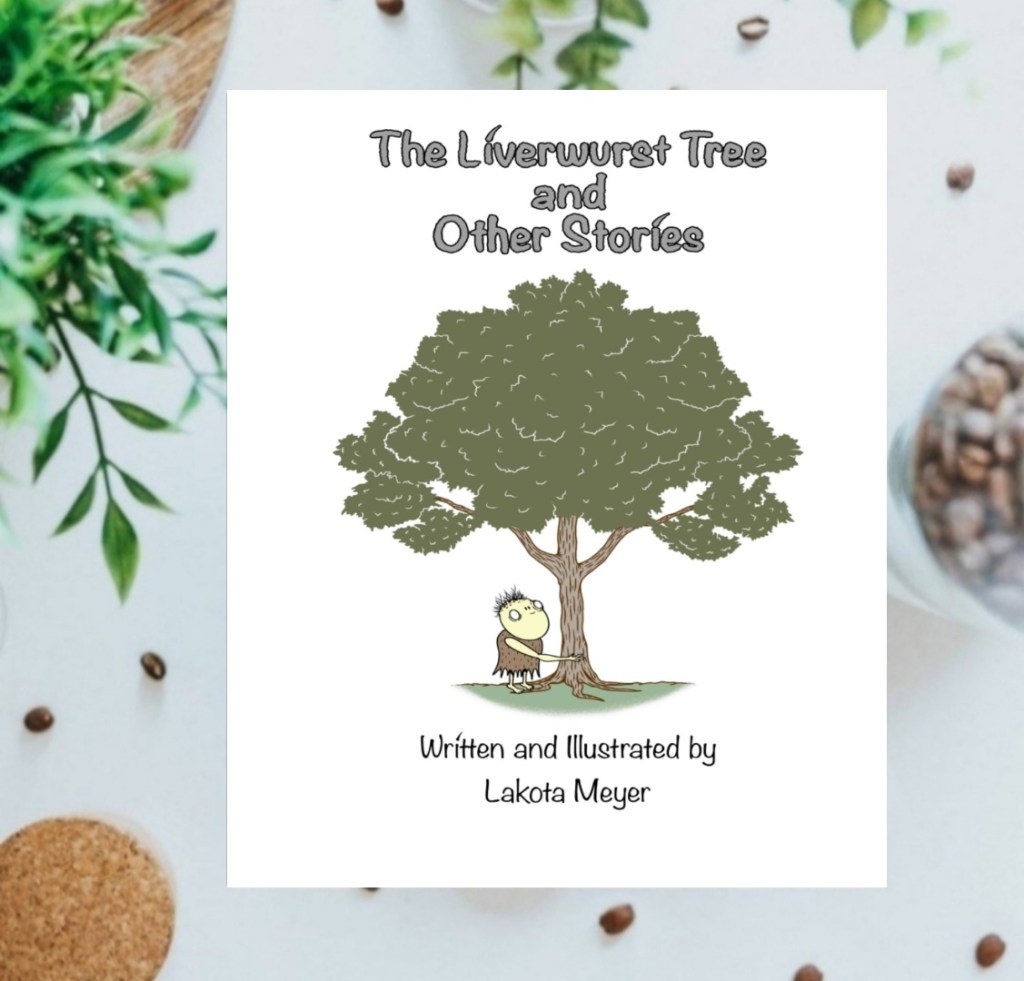
𝗕𝗼𝗼𝗸: The Liverwurst Tree and Other Stories 📚 𝗔𝘂𝘁𝗵𝗼𝗿: Lakota Meyer ✍️ . .
🚀 𝐑𝐞𝐯𝐢𝐞𝐰: ‘The Liverwurst Tree and Other Stories’ written and illustrated by Lakota F. Meyer is a must read book. This book is a collection of poems that would bring a smile on the reader’s face.
“Button Button Who Touched my Mutton” is a rhyming poem. This poem is about a man whose mutton has been touched by someone else in his absence.
Outie Belly Button is a humorous poem about Vincent who has a six inches long belly button. Vincent gets stares from other people because of it but he is unashamed of it.
It’s a delightful read and I enjoyed this poetry collection. Those who appreciate humor would have a great time reading this collection. It’s a short read and readers could finish this anthology in one or two sittings. The writing style of the author is nice. Even if you aren’t an avid poetry reader, you would be able to follow the poems from this book. I recommend this collection to my fellow readers.
Q1. Hello, can you please introduce yourself? Readers would love to know more about you.
Hello! I’m Amelia Cole, and I’m an award-winning fantasy author. My stories have been featured in magazines and in a soon-to-be-published anthology. I’m a huge history nerd, and so I always try and incorporate mythology or ancient stories into my own writing (with a personal twist, of course). When not writing or reading, I play TTRPG games, hike and camp in the mountains of the Pacific Northwest, and binge-watch CW shows.
Q2. What were the key challenges you faced while writing your book “Bridge of Eternity”?
One of the most obvious challenges of writing Bridge of Eternity was describing places in the world that were and still are too dangerous to actually visit. And while in popular tourist areas, there are great resources available online, in conflicted regions, I was lucky to find photos newer than five years old. I also worked actively to incorporate and accurately represent the Arabic culture and language with some very generous forum posters that were from the Middle East with whom I could bounce questions.
Q3. What books or authors have most influenced your own writing?
This is so tough, but I’m a big fan of Madeline Miller’s delicious prose (Circe has a million highlights), I love Raven Kennedy’s world-building and writing love interests with the Plated Prisoner series, and I love all of Patricia Briggs’ stories, she really has figured out the sweet spot of urban fantasy.
Q4. What’s your favourite spot to visit in your own country? And what makes it so special to you?
I’m obsessed with a lakeside campground next to Mt Adams in Washington state. It’s like a postcard, and the looming mountain is breathtaking. Some of my best writing was done there as I sat at a picnic table under the watchful gaze of the snow-covered peak.
Q5. What inspired you to write the book ‘Bridge of Eternity’?
I’ve always had an interest in human civilization through technology and culture. I can’t pinpoint exactly, but I was watching a History channel program or a Youtube about Mesopotamia and came across the Vela supernova. Instantly it fascinated me that the people alive back then were able to witness a real live supernova. A star so bright that they could see it during the day and lasted for months. I can only imagine what they assumed it was, sign from gods, prophecies, literally anything. And then, the real fun is that shortly after, like a handful of years, the Sumerian technology exploded. Writing, metalworking, medicine, all of it seemingly overnight, evolved. While it’s all speculation about a connection, I found this mystery a great inspiration for my story.
Q6. How long did it take you to write your book ‘Bridge of Eternity’?
Two years total.
Q7. On what platforms can readers buy your books?
Its available on Kindle as an ebook, paperback through Amazon, Barnes and Noble, Bookshop.org, and other online retailers. Also, an audiobook is currently in production and will be available soon on Audible.
Q8. Tell us about the process of coming up with the book cover and the title ‘Bridge of Eternity’?
I knew I wanted Ella, my main character on the front of the book and there was an earlier where I had Jason, but decided it really should focus on her. My illustrator was so experienced and made some great suggestions like showing Ella’s magic and dramatic color scheme. She truly was amazing to work with and the cover turned out better than I’d envisioned.
Q9. When writing a book how do you keep things fresh, for both your readers and also yourself?
I used to outline heavily when I first started writing, but have switched to lighter outlines, letting more organic and creativity slip in. I also have a habit of writing down specific scenes when I’m inspired, that are out of order for the story, but I know I’ll add in later. It’s an awesome motivator to have say, chapter 16 and 19 mostly finished and encourages me to fill in the rest.
Q10. What is the most valuable piece of advice you’ve been given about writing?
Oh this is a tough one! I think the biggest hurdle most writers face is self doubt. Doubting if you’re good enough, doubting if the scene should be longer, shorter, or altogether cut. And so I’ve found the best way to overcome this is to connect with other writers. They’ll be your sounding boards, your first beta readers, your cheerleaders, and your shoulders to cry on. They keep you grounded and give you perspective. I’m very fortunate to have a writing tribe (love you, llamasquad!) and wouldn’t be where I am today without them.
𝗕𝗼𝗼𝗸: A Little Superhero Fights Cancer 📚 𝗔𝘂𝘁𝗵𝗼𝗿: Destiny Flood-De Jesus ✍️ . .
🚀 𝐑𝐞𝐯𝐢𝐞𝐰: “A Little Superhero Fights Cancer” written by the author Destiny Flood-De Jesus is a must read book. The story features a young girl named Destiny. She once failed an eye exam at school. Destiny’s parents took her to Dr. Kalpan’s office and ran lots of tests on Destiny’s eyes.
Destiny was sent to a big hospital for more tests and the doctors found a tumor in her right eye. Read this story to know more about Destiny’s journey with cancer.
The story is intriguing. Parents who have a child suffering from cancer should read this book to their little ones so little readers would be strong on their own journey. The illustrations are mind blowing and made me feel connected with the story better. I am glad to get my hands on this amazing book.




 Sassy Reviews