
- Hello, can you please introduce yourself? Readers would love to know more about you.
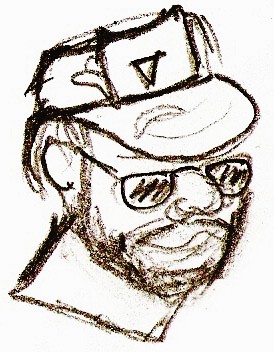
A1. I identify as a philosophy king trapped in a peon’s body.
Born in the Bronx, I grew up in Westchester County New York, on the Long Island Sound.
I have a B.F.A. in Cinema, minors in Political Science and History (5 years in undergraduate studies.) I have a M.S. Ed. in Education (secondary social studies,) finished all my course work for a Master in History (focusing on Recent Chinese and American.) Afterwards I went to Taipei to study Mandarin Chinese at Taiwan National Normal University for 13 months. I have what I call “survival level” Chinese. Meaning if I am in an only Chinese speaking nation I won’t die.
My education has affected my writing style greatly. My cinema background helps me make my stories entertaining and visual. My Chinese , political science, and history are important tools in my stories by making it deeper and more believable.
My education background makes me not want to only tell an engaging story, but to also give my readers something to “chew on,” to think about what they have read long after they put the book down.
I call my narrative style “3rd person Fog-of-War” It lets the reader discover things with the main character, yet not limiting them only in the thoughts of the main character as 1st person narrative does. My narrative style adds to the mystery and tension of the stories, but gives more than 1st person. The reader, like the main character does not always know the intentions or other characters, or what is around the corner until the protagonist does.
I have taught university most of my life. I have taught over 5000 students in the United States as an adjunct professor and a full-time professor at a Taiwan university of eight years, and at a Medical University in Chongqing China for Three years. I have always written my own lessons. I had a textbook published in Taiwan to teach English at the University level along with academic papers of teaching methods. I have taught the following courses: History of Invention and Technology, American History, Intro to Western Civ., European History 1500 – 1815, Cinema History, Media Literacy, Speech Writing and Public Speaking, English Communications I and II, and Medical English.
Q2. What were the key challenges you faced while writing your book “Not For Boys”?
A2. In the story the main character Nathaniel, a 12-year-old boy, moves into a renovated New England factory on a small river that he is told by the locals is haunted. He is warned by the landlord not to enter the south wing of the building. That it is “Not For Boys.” He learns of Her the ghost of a girl that had worked and died on the waterwheel of the factory.
It took me years to discover what was made in the factory over 150 years ago. I wanted to be something that realistic for the times, but may cause negative judgment from the modern reader. One theme of the book is not to judge the past from our modern lens. It is important to better understand those before us, to understand the times they lived in.
Q3. What books or authors have most influenced your own writing?
A3. The writers I have enjoyed the most have been Asimov, Welles, Tolkien, George Orwell, Harry Turtledove, Hemingway, and Rod Serling.
Film directors have also been a major impact on my writing, such as John Ford, Federico Fellini, Sergio Leone, Kubrick, Hitchcock, John Huston, Orson Welles, Ridley Scott, and Akira Kurosawa. Many that have read my stories say they can imagine them on the big screen. I want my stories to be visual.
I also read a lot of non-fiction; history, philosophy, cultural studies, tactics, political science, biographies, autobiographies, and hard science. It is very important that my stories are solid, logical, and believable. I want my readers, especially for my hard Sci-Fi stories, to feel they have entered a living breathing world.
Q4. What’s your favourite spot to visit in your own country? And what makes it so special to you?
A4. I really like New England and the Long Island Sound area. I love the water and the change of seasons. Having lived in subtropical places for so many years, like Chongqing, China and Taipei, Taiwan, I missed the change of seasons.
Q5. What inspired you to write the book ‘The Strange Monkey of Dot Island’?
A5. It is actually a story I first wrote for classmates when we were in elementary school. I was inspired by ‘Curious George’ and my friends seemed to like the strange monkey more so I wrote more. Decades later I rewrote it with my experiences of living in Asia. The story makes a strong contrast between the individual vs. the group, tradition vs. innovation, and learning from nature.
Q6. How long did it take you to write your book ‘The Girl That Never Washes her Hair’?
A6. I first got the premise when my daughter was arguing with my granddaughter to wash her hair. I had been thinking about it for years. It is a short piece meant to be a children’s picture book. When I finally decided to put it down on paper it took less than two weeks.
Q7. On what platforms can readers buy your books?
A7. At the moment I am not selling my books.
If readers would like they can read me for free.
I produced free read along audio books of several of my completed stories and of one that is progress ‘The Last of the Twenty.’ on my YouTube channel (J. N. Wdowski @joewdowski7806) https://www.youtube.com/@joewdowski7806 My longer works are presented in easily digestible 8-to-10-minute segments.
I hope readers will come and enjoy my works and subscribe, comment, like, and share. I am looking into turning my stories into EPUB and MOBI versions, and want to make them into hard print books. Until then if readers would like free PDF versions of any of my stories they can email me at jwdowski@hotmail.com I would be very happy to share.
Q8. Tell us about the process of coming up with the book cover and the title ‘The Wolf and the Little Pig’?
A8. The story is of a little pink pig who transforms a hungry wolf into a “gentleman wolf.” The story highlights the importance of true romantic love vs. animal argues. To advocates for us to better ourselves from our primal instincts in a fun way. So the cover is of a cute little pink pig.
Q9. When writing a book how do you keep things fresh, for both your readers and also yourself?
A9. I write what I enjoy reading. I like entertaining stories, believable characters, thought provokes works, and something I can learn from (I do a lot of research for my stories,) and love twist endings that are surprising, but logical within the frame work of the stories.
For my science fictions, four short stories ‘A.S.,’ ‘My Name is Robert,’ ‘The Days Before Landfall,’ and ‘Ambassador Ford,’ along with my novels ‘For Whom the Gods Fear,’ and my work in progress ‘The Last of the Twenty,’ is very important to me that they are original and creative, yet founded in believable worlds. I feel it makes my stories interesting and fun to read.
Q10. What is the most valuable piece of advice you’ve been given about writing?
A10. “Keep writing.” Which I am doing, there is a lot more to come from me. I have several psychological thrillers and romances that I will be turning into short stories and novels.

 Sassy Reviews