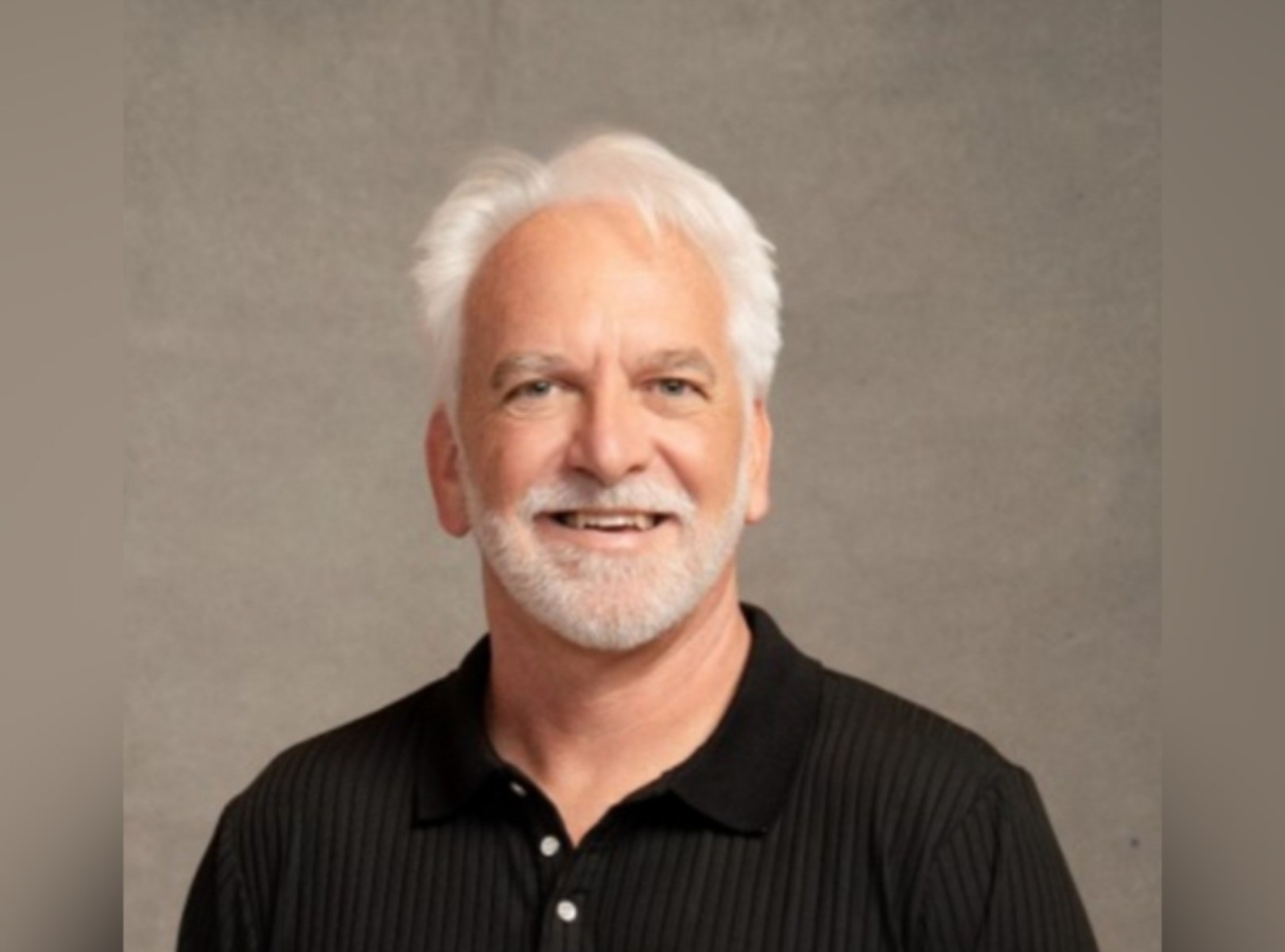
Interview with author Michael Caprio

Q1. Hello, can you please introduce yourself? Readers would love to know more about you.
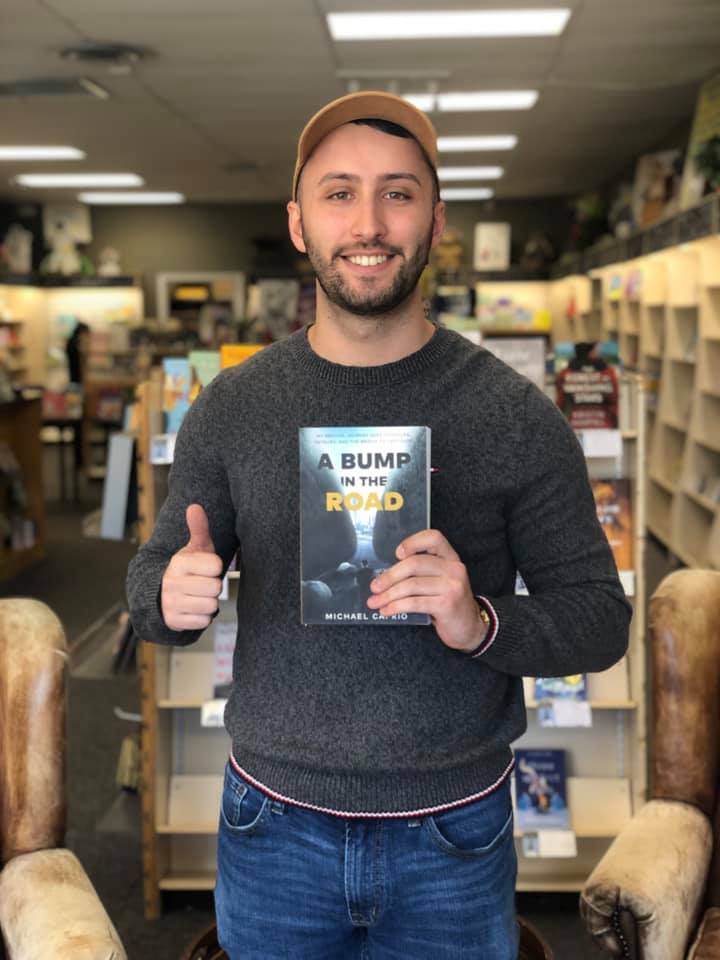
A1. Hello, my name is Michael Caprio and I’m from Hopatcong, New Jersey! When I was 18 years old, shortly after graduating high school, I was diagnosed with a rare genetic condition that runs in my family called Familial Adenomatous Polyposis. What that means is I have a gene in my body that doesn’t stop the growth of polyps, instead, they multiply. Polyps are precancerous growths that can grow anywhere in your digestive system and if left untreated can turn into cancer. With my condition, this occurs within the Large Intestine primarily but could occur elsewhere though it is less likely. With that being said the treatment plan for my condition is to have the entirety of my large intestine removed before the polyps turn cancerous.

Q2. What were the key challenges you faced while writing your book “A Bump in the Road”?

A2. Some challenges I faced when writing my book was deciding whether to include or omit moments that would be considered vulnerable or embarrassing. Considering the nature of my surgeries and my condition I was faced with a lot of those moments and not including them felt like a disservice to others out there going through the same thing behind closed doors. This is why in my book I decided to keep all of those moments in, no matter how shocking the subject matter might seem to show the real struggle of what happened behind closed doors. Another challenge I was faced with was the handling of my family’s medical history and sensitive medical information in general. I didn’t want to publish anything misleading or flat wrong, so I put a lot of effort into researching my family history with the disease as well as my family’s doctors who saved our lives. For some things that I wasn’t 100% sure about I had my surgeon double check to make sure it was accurate, just to give an idea of the lengths I went to make sure everything was accurate.

Q3. What books or authors have most influenced your own writing?

A3. I read a wide variety of books ranging from memoirs to science fiction so it is difficult for me to say one author or book in particular has influenced me but I can list a few of my favorite books for what it’s worth! Atomic Habits by James Clear, The Dune Series by Frank Herbert, Outlive by Peter Attia, and Meditations by Marcus Aurelius.

Q4. What’s your favourite spot to visit in your own country? And what makes it so special to you?

A4. As a person who was raised in the New York Metropolitan area, I love to visit places that are more south of me. One of my favorite places is Washington D.C., our nation’s capital. It’s a special place for many reasons but for me in particular it’s a place me and my family always vacationed to since it wasn’t that far and we could travel by car. It always brings back fond memories of going to Nationals baseball games and visiting all the historical sites with my family, which there is an endless supply of. We have been visiting for twenty years and we always find something new to do. Another special place to visit is Virginia/Virginia Beach for similar reasons, it was a place my family always vacationed to for most of my childhood and we still occasionally visit. The New York Metro area will always be home to me but it’s nice to go down south where the pace of life is a bit slower every once and a while.

Q5. What inspired you to write the book ‘A Bump in the Road’?

A5. It was a gradual process and many factors contributed to me writing the book but I think the biggest reason was to leave a legacy for my grandparents. That’s not to discount all the other reasons, including documenting my journey in great detail so that the other people with FAP or similar conditions out there can not feel alone and have a reference to look to since no one talks about these conditions in particular. However, I can’t deny that the biggest influence was my grandparents and my grandma in particular. She had devoted most of her life to being a guinea pig essentially so that my life could be easier and my journey was certainly much easier than hers. Her persistence and strength inspired me and still inspires me to this day and I wanted to share that with the world.

Q6. How long did it take you to write your book ‘A Bump in the Road’?

A6. Officially it took me about a year working with editors and my publisher but I had been writing my story many years prior on my laptop unofficially. Before I had the help of my publisher I had the idea that maybe one day this could become a reality and I didn’t want my memories to fade of how things transpired before, during, and after my surgeries. So I started to document my memories on Google documents hoping that one day I would meet someone who would be able to trim it up for me and give me the guidance I needed.

Q7. On what platforms can readers buy your books?

A7. My book can be found on all platforms including Amazon & Barnes & Noble!

Q8. Tell us about the process of coming up with the book cover and the title ‘A Bump in the Road’?

A8. For the book cover, I must give all credit to the lovely editing team at New Degree Press which is now called Manuscripts. They drafted up four or five versions of the cover and I chose which one I liked the most and we would keep doing revisions until we got it perfect. All I did was say “I like this” or “I don’t like that”. They did all the creative work on that and should get all the credit, it came out perfect in my opinion! As for the title, it came from a saying my dad used to repeat all the time during my surgeries and recoveries as a means to keep us all calm. He kept saying “It’s just a bump in the road, we’re going to get through this.” And it was just a bump in the road as life is all good now and so the name stuck.

Q9. When writing a book how do you keep things fresh, for both your readers and also yourself?

A9. Considering the subject matter of my book can get a bit dark without humor or moments of levity I decided to incorporate a fair amount of self-deprecating humor to keep things light. I also tried to include a lot of active metaphors to keep readers engaged and paint a more detailed picture of the events I was going through and the pain I was feeling. Also, I chose to incorporate some pop culture references from entertainment that I like to give the reader a better insight into me as a person.

Q10. What is the most valuable piece of advice you’ve been given about writing?

A10. To be fully transparent and leave it all out there, for better or worse. Writing at the end of the day boils down to having an opinion or a story to share about something. You can’t do that if you are afraid to be fully transparent and speak your mind or your truth. It won’t be authentic if you do otherwise and the reader will be able to tell. Don’t betray yourself and be authentic.

Buy A Bump in the Road on Amazon
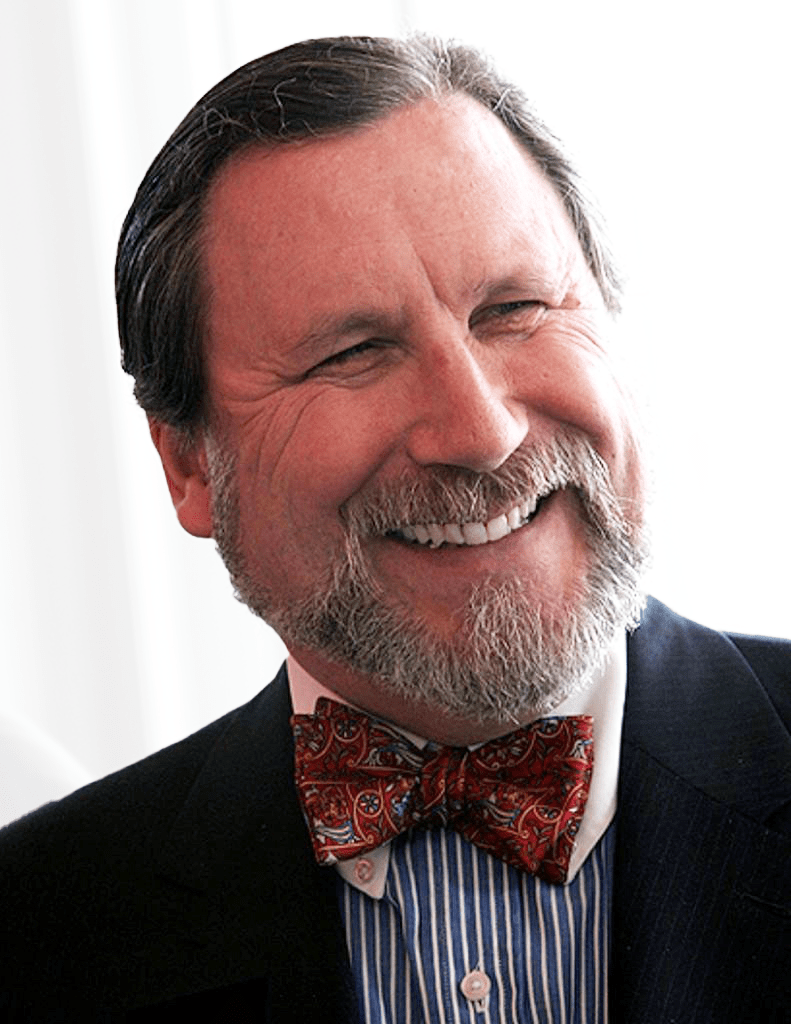
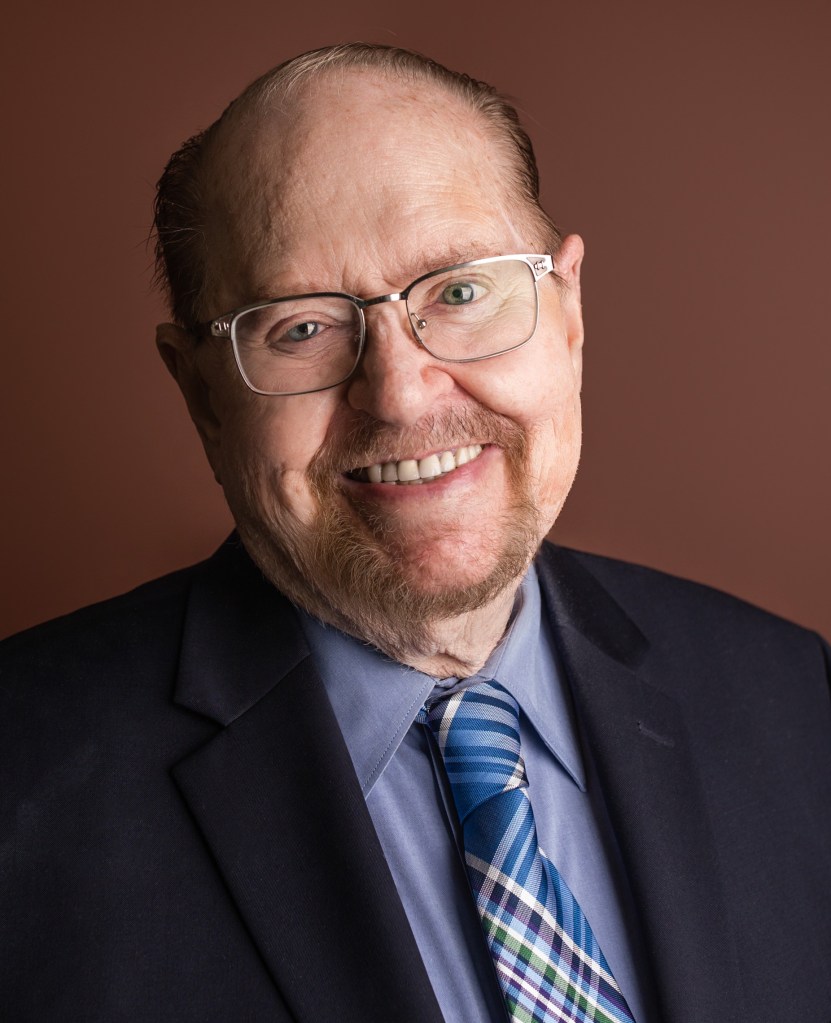
Interview with author Pierre R. Schwob

Q1. Hello, can you please introduce yourself? Readers would love to know more about you.

A1. I suppose I’ll start with my name, which is Pierre – although I was born Peter in Los Angeles. My family moved to Geneva, Switzerland when I was a toddler, where I became-and remained-Pierre. I moved back to the States in my late twenties and took on various jobs. None particularly intellectually challenging. I started to play chess fairly seriously. In 1975, I co-authored a book on chess openings. My publisher, knowing of my interest in math, asked me if I could write a book on, the then new-to-market, calculators. It did fairly well, picked up by some mathematical book clubs. I then approached McGraw Hill about publishing a book that would contain the major historical documents of the world. That idea came to me as the Watergate scandal was exploding and I wanted to read the U.S. Constitution for myself. The Internet wasn’t yet a thing and I couldn’t find the text in my (large) bookshelf. McGraw Hill immediately approved the project and that became my third book (although I am listed as Editor.) To help with my research, I needed to compile various databases. I built various personal computers from kits (ALTAIR, IMSAI, etc.) and immediately realized that I had to teach myself software programming. This got me sidetracked for decades! I eventually taught computer science at various universities. During these years, I also developed and patented new technologies for radio receivers that eventually became part of a U.S. national standard. But to be closer to my potential licensing clients (the big guys in Japan), I moved to Hong Kong, where I stayed for eleven years. Right after the start of the World Wide Web, I started a small website called the Classical MIDI Archives. Upon my return to the states in 1997, I moved to Silicon Valley, close to Stanford, and continued to develop the site which eventually became ClassicalArchives.com, one of the largest classical music sites in the world. As one of my passions is astrophysics and cosmology, I got involved with Stanford’s physics department. In my spare time, I try to visit as many labs and research centers as I can. This brought me to the deepest mines, the highest observatories and other fascinating locations around the world. I even spent time at the South Pole. Asteroid (32890) Schwob has been graciously named after me. I am one of longest serving member of the SETI Institute’s Board of Directors. Now that AWE: A technothriller (focused on climate change, AI, fake news, and international cooperation) is out, I am thinking of writing another novel, addressing the benefits and dangers of AI.

Q2. What were the key challenges you faced while writing your book “AWE: A technothriller”?

A2. As AWE is my first novel, I had to learn to “kill my children:” to remove characters, whole passages, even entire chapters. Serve the story. Another challenge was the immense amount of research I had to undertake. Particularly as the science and technology is so fast-moving in the areas the novel covers.

Q3. What books or authors have most influenced your own writing?

A3. A tough question as I read fairly voraciously. But my taste centers on science, foreign affairs, history (even older works like Edward Gibbon’s The Decline and Fall of the Roman Empire, Will and Ariel Durant’s The Story of Civilization), and thrillers. I can name Stephen Greenblatt’s The Swerve, Carl Sagan’s entire output, Stephen Weinberg’s The First Three Minutes, Lenny Susskind, Brian Greene, Sean Carroll, and many others. As to thrillers, I’ve read John Sandford’s Prey entire series twice(!), Daniel Sylva, Jason Matthews, and many others. Matthews’s Red Sparrow was an inspiration for my offering a playlist in my book (a classical music work to play at the beginning of each chapter), although that idea also sprang from an experience I had when I read a novel at fourteen while my gramophone was playing in the background–recounted on my website (www.prs.com).

Q4. What’s your favorite spot to visit in your own country? And what makes it so special to you?

A4. I am a Swiss/US dual citizen. I suppose that I have to mention Stanford University for its beautiful Romanesque campus and contagious intellectual ferment. Otherwise, I shouldn’t miss mentioning the Swiss Alps and their meadows. Gorgeous wild flowers in the spring and summer, and glorious snow in winter. (Learned to shoot down airplanes-on-a-wire from my troop carrier there, while in the Swiss Army.)

Q5. What inspired you to write the book ‘AWE: A technothriller’?

A5. While some will take offense, it was the deplorable response to COVID-19 from a previous administration, its reckless lack of interest in climate change, and the self-sabotaging China Initiative (thankfully ended but now rearing its ugly head again.)

Q6. How long did it take you to write your book ‘AWE: A technothriller’?

A6. About a year to write a complete draft. Another year to massage it into shape. And then three weeks to select and build the playlist, available on ClassicalArchives.com.

Q7. On what platforms can readers buy your books?

A7. Amazon, as a hardcover, paperback, or on Kindle–both in a flowing text, and as a print-replica. (The latter for those who wish to enjoy the author-selected fonts.) You can also find a link to Amazon’s AWE page on my website at http://www.prs.com, where readers can read more about the book, the playlist, contact me, or ask for a personalized signed bookplate.

Q8. Tell us about the process of coming up with the book cover and the title ‘AWE: A technothriller’?

A8. As the main themes of the book is climate change and rigorous science, I wanted the cover to be simple and direct. I selected an image of the Earth taken by a NOAA satellite. The title is an acronym for “Artificial Wisdom Engine” – an AI which becomes one of the novel’s protagonists.

Q9. When writing a book how do you keep things fresh, for both your readers and also yourself?

A9. I’ve never given a thought to this. The creative endeavor never seems to get stale. I find that developing a plot is very much like playing chess, when you have to think ahead many moves, offering hints that presage the action to come. The key is to continuously place unexpected obstacles that the protagonists must overcome. I get a lot of help from my characters as they evolve. As most authors will tell you, they do take a life of their own. And their personalities, likes and dislikes, strengths and weaknesses, particularly their sense of humor (when they have one), help keep things interesting.

Q10. What is the most valuable piece of advice you’ve been given about writing?

A10. I’ll repeat what I said earlier: learn to “kill your children!”

Buy AWE: A technothriller on Amazon

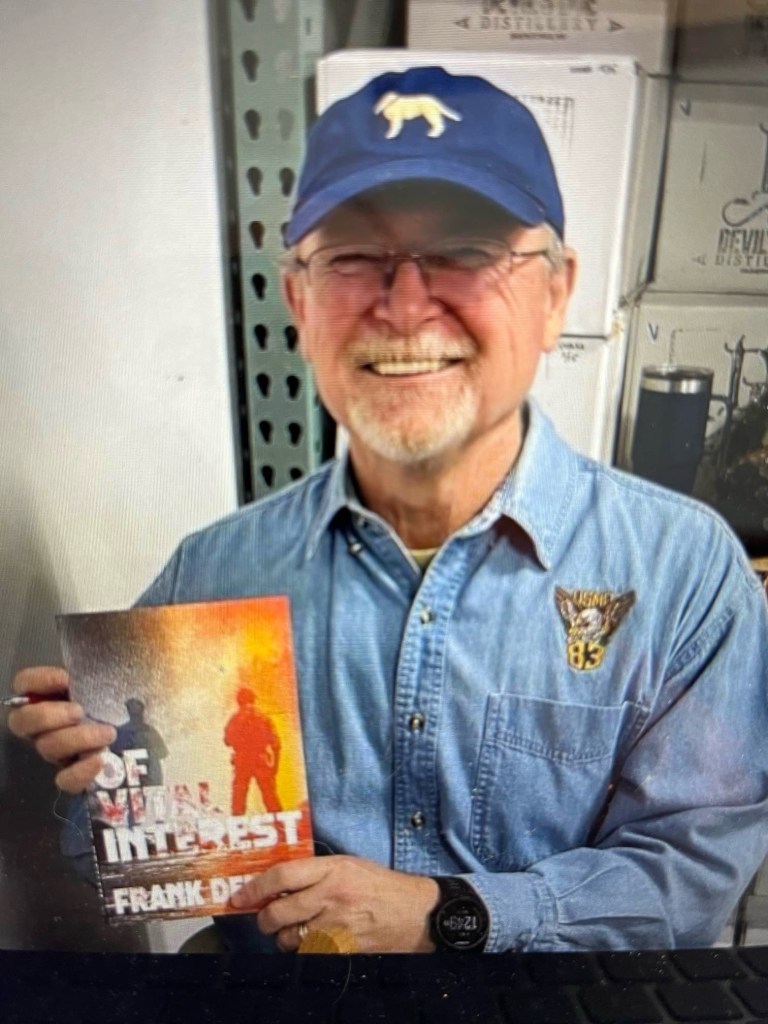
Interview with author Frank Demith

Q1. Hello, can you please introduce yourself? Readers would love to know more about you.

A1. My name is Frank Demith. I am an Army veteran having served twenty-eight years on active duty. I am also a 1983 graduate of the United States Military Academy. I currently live in Martinsburg, WV.

Q2. What were the key challenges you faced while writing your book “Of Vital Interest”?

A2. I wanted to make sure to make my book something that anyone could enjoy. That meant that I would have to add some detail about what was happening and limit the use of acronyms. I also wanted to make sure to include some strong secondary characters in addition to the main characters. There are many different story lines in the book, but I thought they were essential in telling the story and letting the readers have a deeper understanding of what our men and women in the Armed Forces go through when they deploy to a foreign country,

Q3. What books or authors have most influenced your own writing?

A3. I enjoy reading all books but am mostly interested in the classics and modern suspense/thrillers. My favorite authors have been Dickens, Tolstoy, Tom Clancy, Vince Flynn and Harold Coyle.

Q4. What’s your favourite spot to visit in your own country? And what makes it so special to you?

A4. That would have to be my Alma Mater, the United States Military Academy. It is packed with history and amazing views. I will always feel indebted to this institution for allowing me to become the person I am today. It was an amazing experience which has resulted in a wonderful life.

Q5. What inspired you to write the book ‘Of Vital Interest’?

A5. I wanted to share stories of the amazing people I had a chance to work with while in the Army. Each character in the book is a compilation of several individuals I came across while serving in the Army. Not much had been written about the contributions of immigrants to the war effort so I wrote this book for the more than 1500 individuals who joined the Army to serve as interpreter/translators.

Q6. How long did it take you to write your book ‘Of Vital Interest’?

A6. I wrote this book in 90 days.

Q7. On what platforms can readers buy your books?

A7. My book is available through a number of online sources to include: Barnes and Noble; Amazon; Target; Walmart and dozens of other utlets. Individuals who would like a signed copy can contact me through my website at http://www.frankdemithauthor.com

Q8. Tell us about the process of coming up with the book cover and the title ‘Of Vital Interest’?

A8. The title is taken from another program which also recruited individuals for their language and cultural expertise. That program was called Military Accessions Vital to National Interest. The book cover is my way of illustrating the conflict between the two main characters and highlighting the fact that there are different shades of reality in war depending upon an individual’s perspective but the one commonality is bloodshed.

Q9. When writing a book how do you keep things fresh, for both your readers and also yourself?

A9. I am a very structured writer. I spend several weeks developing an outline that covers main points for each chapter, and then I do short character sketches. That keeps me focused on writing and allows me to move through the storyline without leaving things out. I also like to use foreshadowing as I write to give the readers that “Oh yah” momement when they realize something had been said earlier about that topic.

Q10. What is the most valuable piece of advice you’ve been given about writing?

A10. That would be “write what you know”. It sounds so simple but it is so important for me. I enjoy writing fact based fiction, and I’m not really making things up, I am telling stories. Hopefully they willl continue to be stories that others can enjoy.

Buy Of Vital Interest on Amazon

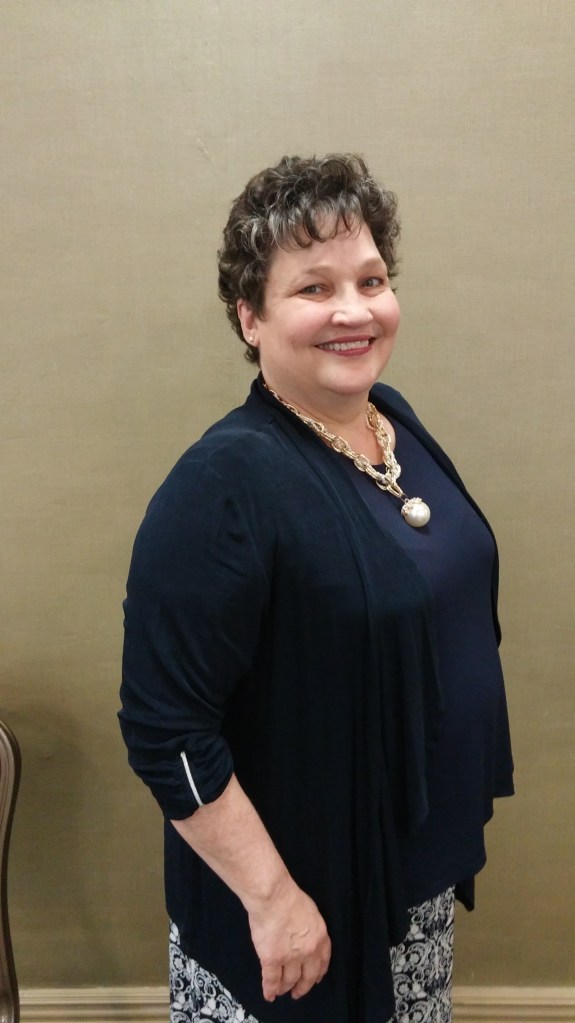
Interview with authors Bobby R. Patton, Rusalyn Andrews & Jennifer Daily

Q1. Hello, can you please introduce yourself? Readers would love to know more about all three of you.

A1. The three authors knew one another socially, but live in different communities. They first met in early 2017 to share concerns over the many factors influencing the nation’s alarmingly declining health. They realized that the choices made in communication, often reflexively and habitually, make a difference whether the results are healthy or unhealthy. They decided it was time to create a book that identities detrimental communication practices associated with unhealthy outcomes and suggests healthy communication alternatives.

The authors come from diverse backgrounds. Their ages span three generations; their academic resumes differ, and their life experiences both professionally and personally are varied. Bobby R. Patton (Ph.D., University of Kansas, 1966) has been a communication scholar, a professor and an administrator at four major public universities, including serving as President at the University of Central Missouri. He has co-authored sixteen highly regarded college textbooks in the area of interpersonal communication and decision making. In 2021 he received the Albert Nelson Marquis Lifetime Achievement Award. Rusalyn H. Andrews (Ph.D., Southern Illinois University, Carbondale, 1989) is a professor emeritus of Cottey College, a private women’s liberal arts institution. She has taught courses in communication, theatre, and women, gender and sexuality studies. She has rich international educational experiences, including a Fulbright Award to do research in Russia, and specialized training in Deaf Culture. Jennifer Page Daily, (M.D., University of Nevada, 2007), the youngest member of the team, is a Board-Certified Family Practice Physician with a Certificate of Added Qualification in Primary Care Sports Medicine. She is a Professor at the University of Louisville in the Department of Family and Geriatric Medicine. She serves as director for the Introduction to Clinical Medicine, a pre-clinical course for all university medical students. In 2018, Dr. Daily was the recipient of the Department’s Excellence in Teaching Award and Outstanding Faculty Award. She also was named a 2018Inspirational Physician by the American Medical Association Women Physicians Section. In 2020 she received the Exemplary Teaching Award from the Kentucky Academy of Family Physicians, and in 2021 she was named a member of Alpha Omega Alpha National Honor Medical Society.

Q2. What were the key challenges you faced while writing your book “Keys to Healthy Communication”?

A2. The key challenge consisted of accurately reporting the daily events involving the COVID pandemic and reconciling the contradictions.

The five years spent preparing this book obviously included the COVID-19 pandemic as it spread across the globe. The authors began their project with the intent to avoid politics, but the crisis became political from the outset. While the authors did not know each other’s political beliefs at the beginning of the project, they were united in their belief in truth and science based on verifiable evidence. They utilized consensus to maintain a shared view of reality. Sadly, by the end of 2021, over 800,000 Americans had died from the COVID-19 virus.

Q3. What books or authors have most influence your own writing?

A3. The following scholars greatly influenced our data base and writing: Carl Rogers for providing the theoretical grounding for this work and, additionally, Kim Giffin (trust). Sidney M. Jourard (humanistic psychology), Daniel Goleman (neuroscience; multiple intelligence), Steven Pinker (cognitive psychology and human nature), Michael Marmot (health determinants), Jonathan Page (neuroscience and cognitive control), Dr. Harriet Lerner, an expert on relationships, and a staff psychologist at the Menninger’s Clinic; as well as numerous others who are noted in the endnotes to each chapter.

Q4. What part of the book did you have the hardest time writing?

A4. As stated in the book, the authors followed closely what was happening as the COVID-19 virus spread around the world, and they attempted to avoid politics. When our political leaders made what appeared to be major important decisions, they had difficulty remaining non-partisan. The authors did their best to rely upon truth and science, as they maintained a shared view of reality. They had difficulty remaining impartial while over 800,000 died for the COVID-19 virus by the end of 2021, some needlessly. Hopefully we can avoid the choices in the future.

Q5. What inspired you to write the book ‘Keys to Healthy Communication’?

A5. The authors were moved to write the book by their questioning why the U.S. health treatment is declining (compared to other economically leading countries) while spending the most of any other country in medical costs (National Center for Health Control and Prevention, July 2, 2021 – Report was the latest we saw.) A key for the authors was the median age of the deceased population reported on an annual basis. Until 2016, the U.S. population had the oldest median age at death. Since then, the U.S. average age of death has decreased annually, while other countries have been rising. During this same period of time, the U.S. expenditures for healthcare continued to rise in comparison to other leading countries.

Q6. How long did it take you to write ‘Keys to Healthy Communication’?

A6. We began our research in 2017 with writing beginning in 2018. Chapters started to be exchanged in early 2019. By the end of that year, the COVID virus made in-person meetings difficult, forcing the authors to rely on electronic communication. They worked out the responsibilities and a project schedule. A full draft was completed in late 2021 and the submission of the complete manuscript, approved by all three authors, was submitted for a February 22, 2022 release (2-22-2022!)

Q7. On what platforms can readers buy it?

Our distributors platforms were Ingram Spark and Amazon for worldwide distribution. We elected a print-on-demand availability to permit sales without forcing dealers to order stocks in advance. We have promoted sales on an international basis. Among our purchase links are all major bookstores (internationally), including:
Nook on B&N and Barnes & Noble
Waterstones
Booktopia
Kobo
Booksamillion
Walmart
Indigo
AbeBooks
Bookshop by Indiebound
eCampus

Q8. Tell us about the process of coming up with the book cover and the title ‘Keys to Healthy Communication’?

A8. Three artists were selected to prepare first drafts of the cover. We all liked the one selected for its reflection of our book’s content and attractiveness. With minor suggestions, the first cover was selected and approved. The title for the book was determined by reactions of early readers to describe the contents.

Q9. When writing a book how do you keep things fresh, for both your readers and also yourself?

A9. We had no trouble “keeping things fresh” due to the rapid occurrence of new facts virtually daily. We are pleased that the facts as we reported have been verified by time and long-term results. We, at this time, see no depictions that need to be changed.

Q10. What is the most valuable piece of advice you’ve been given about writing?

A10. We repeatedly told one another to keep writing and rely on our co-authors to question and offer suggestions. We believe we had a good team and truly practiced “healthy communication!”

Buy Keys to Healthy Communication on Amazon

Interview with author Lee Alexander

Q1. Hello, can you please introduce yourself? Readers would love to know more about you.

A1. I am from Louisville, KY and now live in Virginia Beach, VA with my wife and four children. Most of my children are adults now and one still in high school. I’m a veteran of thr US military and work full time as an IT professional contractor with the US military. D&D, dark fantasy, horror movies, and odd history are things I enjoy.

Q2. What were the key challenges you faced while writing your book “Shadows of the Past”?

A2. I write my books with pen and paper, so one challenge is when I begin to type them out I have to decipher my own handwriting. Also, I tend to have a lot of ideas for the next book while writing and have to refocus myself on the current book.

Q3. What books or authors have most influenced your own writing?

A3. Edgar Allan Poe, Topher Metcalf, and Stephen King

Q4. What’s your favourite spot to visit in your own country? And what makes it so special to you?

A4. Louisville, KY. It is home and no matter how far I traveledor how long I have been gone, my foundation is always there. A specialspot in Louisvilleis Zachary Taylor cemetery. I grew up playing in the cemetery and had a lot of supernatural experiences there.

Q5. What inspired you to write the book ‘Shadows of the Past’?

A5. I was actually working on a D&D based novel and was stuck at one point. The idea of Damien came to me as I sort of see myself, not a demon slayer, but with inner demons to battle.

Q6. How long did it take you to write your book ‘Shadows of the Past’?

A6. From pen to paper and typed out it was about ten months. Hopefully book two is quicker.

Q7. On what platforms can readers buy your books?

A7. Barnes and Noble, Amazon, and it is coming to Target and Apple. It should be available world wide on mist platforms soon.

Q8. Tell us about the process of coming up with the book cover and the title ‘Shadows of the Past’?

A8. I wanted something simple and defining of the book. I came up with a basic idea and my editor, Em , helped with some ideas also. We had three ideas and I asked my familyand close friends to tell me thier favorite, which matched my favorite, so Damien with hos back to us made Sadows of the Past feel like it was behind him.

Q9. When writing a book how do you keep things fresh, for both your readers and also yourself?

A9. I do whatever I can took keep the story moving and introduce new characters and leave small openings for the characters to reveal more about themselves as I go.

Q10. What is the most valuable piece of advice you’ve been given about writing?

A10. My friend and mentor, Chris M., told me my opening paragraph sucked the first time he read my writing. He explained the old used up, it was a dark amd stormy night, type of writing was not what people wanted anymore. Make that opening paint a picture of the story not just the scene. I have taken that to heart and appreciate his bluntness very much.

Buy Shadows of the Past on Amazon

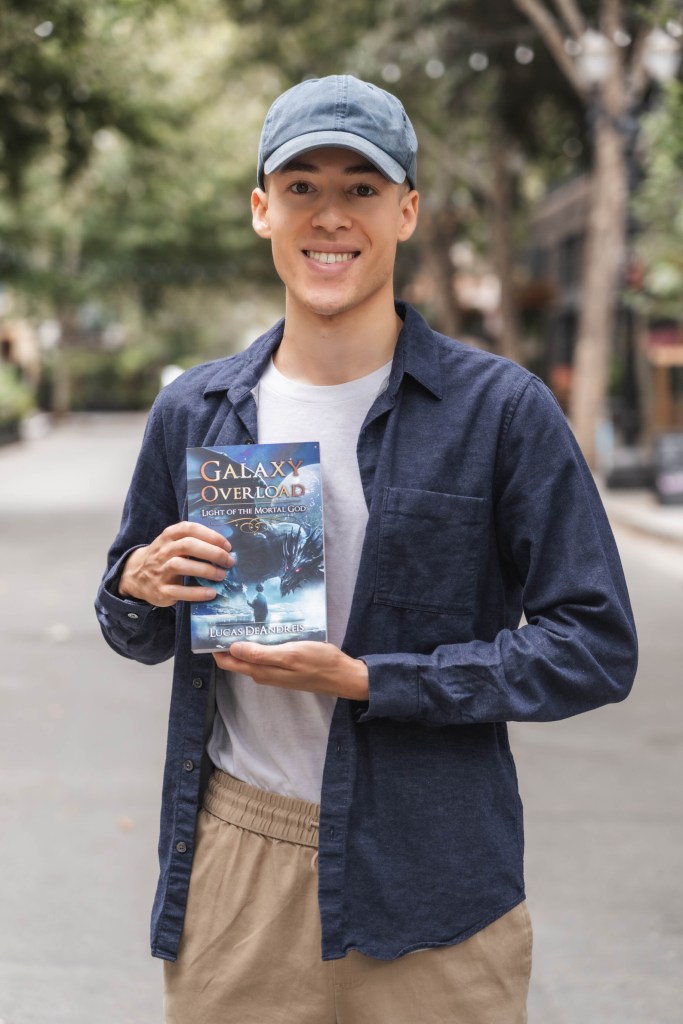
Interview with author Lucas DeAndreis

Q1. Hello, can you please introduce yourself? Readers would love to know more about you.

A1. I was born in San Mateo, California in 1996. Growing up, surprisingly, I wasn’t the biggest writer or reader. In fact, It was my worst subject. My mother would put me in extra reading classes in elementary school every year in hopes of getting me interested but it just wasn’t clicking. I only liked sports, especially soccer, which was my passion during childhood. It wasn’t until my mother bought me the Percy Jackson series by Rick Riordan for Christmas one year before things began to turn. And that created the domino effect for getting me interested in other books and authors.

Q2. What were the key challenges you faced while writing your book “Light Of The Mortal God”?

A2. One of the challenges I faced was the constant changing in story from when I created the idea of the novel. At first I thought it would just be a simple dystopian science fiction novel. And then more and more as I got into it the path of the story and the depth of the characters kept changing that I had to rewrite it a few times. But once I finally got it right, it is without a doubt my favorite book out of all the stories I’ve written.

Q3. What books or authors have most influenced your own writing?

A3. Growing up I was a huge fan of the Percy Jackson novels by Rick Riordan. He created a really compelling character that I related with plus the world building from start to finish was second to none. Tolkien’s Lord of the Rings is another series that is so immersive and jaw dropping for me. The sheer scope of the story he created is incredible. I’m also an avid manga and comic book reader. Akira Toriyama’s Dragon Ball is something I probably read every other year. I definitely have been influenced by these author’s world building techniques and likeable characters that are full with personality. I think that’s the main ingredient to delivering a compelling novel. Interesting worlds that get more vast and complex, interesting and likeable characters with personality, and an engaging plot that doesn’t stop.

Q4. What’s your favourite spot to visit in your own country? And what makes it so special to you?

A4. My favorite spot to visit is probably Los Angeles. I love Disney Land and have been so many times. It’s special just cause of the all stories I grew up with being live and all around you. It’s something to admire that one studio could create so many ingenious stories and to keep going till this day.

Q5. What inspired you to write the book ‘Light Of The Mortal God’?

A5. Before writing novels, I was actually writing screenplays. I’m a big film fanatic and so I wrote a few scripts which I would do on my free time after school. One day my mom said why do you only write screenplays and why don’t you write a novel too and just threw that idea out there. I hadn’t thought about it but I actually took a script idea that I was going to write for a screenplay and adapted that idea and that became the basis for my novel ‘’Light Of The Mortal God’’.

Q6. How long did it take you to write your book ‘Light Of The Mortal God’?

A6. It took me almost 2 years. I had to juggle school and it was hard to stay consistent. But over time I finished and it was such a good feeling.

Q7. On what platforms can readers buy your books?

A7. Readers can buy it on many different platforms but Amazon is the one I recommend.

Q8. Tell us about the process of coming up with the book cover and the title ‘Light Of The Mortal God’?

A8. Towards the beginning of the book a tragic event happens that sets the main character, Roy, on a path so terrible from his former life. Roy gets taken from his mother arms and has to live with the convicts on Pluto. But, one day everything changed, he meets a friend. A creature of mystery who’s feared by everyone except Roy, who finds the goodness in him. I wanted to showcase this scene that sticks out which sets up the rest of the story. Light of the Mortal God, without spoiling too much, refers to Roy, from not only his divine past but mainly the light and goodness from his heart that separates him from any immortal God.

Q9. When writing a book how do you keep things fresh, for both your readers and also yourself?

A9. I’m someone that gets bored really easily so I need a lot of interesting things to happen. So that’s one of my techniques is to always have a compelling plot point happening to move the story at a brisk pace. Pacing is key in stories. But not only that, the main thing is the characters. If one makes great characters readers don’t care what happens really. Harry Potter can go on for 7 books and 8 movies because we love the characters so much, they can be doing anything and we’ll still tune in for the next book or movie. That’s my strategy. Great characters with personality and engaging plot ideas.

Q10. What is the most valuable piece of advice you’ve been given about writing?

A10. To just learn the craft and keep writing. I remember my first screenplay I sent into a big Hollywood contest. I paid for judge feedback and surprisingly the script was in the top 10% of scores. The script was a mess though and not formatted right and I had no idea what I was doing but the judge gave me some great advice that even though you’re talented you need to learn the technical aspects of writing. Being a great writer isn’t just having a great idea but there are rules and you need to understand these rules and grow. So that was a big piece of advice I received.

Buy Light of the Mortal God on Amazon

Interview with author Michael Scarlett

Q1. Hello, can you please introduce yourself? Readers would love to know more about you.

A1. Every introvert’s worst nightmare, but now that we have that out the way…I grew up in Knoxville, Tennessee where I spent most of my life. I am married with three wonderful kids. Our twin daughters have blessed us with seven grandchildren and now the pressure is on our recently married son. But seriously, we moved around some after the breakup of our church in’97, but that’s a story for another day and another book. We were in Florida for eight years and now happy to be back in Tennessee, residing in Hendersonville.

Q2. What were the key challenges you faced while writing your book “The Quiet Kid”?

A2. Balancing time between a full time job and family and still carving out the time to write.

Q3. What books or authors have most influenced your own writing?

A3. There are so many. The first was probably Harper Lee ~ To Kill a Mockingbird. Kurt Vonnegut got me hooked and then came Cormac McCarthy ~ All the Pretty Horses. I love the way he handled dialogue.

Q4. What’s your favourite spot to visit in your own country? And what makes it so special to you?

A4. Anna Maria Island. So many good times with family there. My wife and I took a road trip out to Bryce Canyon a couple of years back. I’m itching to get back out there to see more of the state and more of the Rocky Mountains.

Q5. What inspired you to write the book ‘The Quiet Kid’?

A5. Conversations with my son about my high school days, which stirred his curiosity. I became acutely aware of my lack of knowledge about my Dad’s early years, so I just started writing things down

Q6. How long did it take you to write your book ‘The Quiet Kid’?

A6. I wrote for almost thirteen years before concluding that I actually had two books going simultaneously. I spent another year or so breaking it apart before self publishing The Quiet Kid.

Q7. On what platforms can readers buy your books?

A7. Amazon

Q8. Tell us about the process of coming up with the book cover and the title ‘The Quiet Kid’?

A8. I wanted the cover to reflect the times, so I drew up a rough sketch of me flashing the peace sign out the window of the first car I owned and pitched it to a friend with the idea of some Peter Max style pop-art. Kudos to Brad Smith for the brilliant job! As for the title, it was how I was known, especially to those who didn’t know me well.

Q9. When writing a book how do you keep things fresh, for both your readers and also yourself?

A9. I always try to get inside the moment and draw the reader in with me. That’s the goal.

Q10. What is the most valuable piece of advice you’ve been given about writing?

A10. “Write to please just one person. If you open a window and make love to the world, so to speak, your story will get pneumonia.”
Kurt Vonnegut

Buy The Quiet Kid on Amazon

Interview with author Paula Stahel

Q1. Hello, can you please introduce yourself? Readers would love to know more about you.

A1. I’ve been a Tampa-based writer and editor for decades, working primarily in non-fiction and memoir. For more than 20 years I specialized as a personal historian, and am proud to have been a pioneer of the profession. But when covid made it impossible to conduct in-person interviews, I concentrated on editing fiction—I really enjoy helping authors improve their work. My mantra is “Every writer needs an editor,” which applies to my own work, as well!

Q2. What were the key challenges you faced while writing your book “Undone: A Novel of Betrayal”?

A2. First was making the time to write. Then there was the fleshing out the characters—both the ones who were planned and the ones who literally walked themselves onto the page! Also, a lot of research was needed for the more “technical” issues, such as the financial situations Lydia dealt with, and the medical situation at the end of the story.

Q3. What books or authors have most influenced your own writing?

A3. Oh my gosh, where to begin?!? The two writers who made me think I should pull a Lillian Hellman and toss the keyboard out the window are Pat Conroy and Rick Bragg. Conroy is, in my estimation, the greatest writer of Southern fiction of the last half of the 20th century, and Rick continues to be the greatest writer of Southern non-fiction. Both write such poetic, lyrical sentences—but Bragg makes you laugh a lot more.

Other than those two, if I started listing, it alone would turn into a book!

Q4. What’s your favourite spot to visit in your own country? And what makes it so special to you?

A4. Again, not an easy question to answer. I do love visiting Michigan and the Upper Peninsula in the summer but no more winters there for me! So, my real answer is again a two-fer: San Francisco and New Orleans.

Q5. What inspired you to write the book ‘Undone: A Novel of Betrayal’?

A5. After experiencing a betrayal myself, I read so many books about betrayal. None of them were what I was looking for—a story where a woman got her due. So I took Toni Morrison’s advice and wrote the book I wanted to read. And while living well may be the best revenge, so is publishing!

Q6. How long did it take you to write your book ‘Undone: A Novel of Betrayal’?

A6. I started in late 2016 and finished the first draft three years later—I was writing only on weekends, as clients took precedence on weekdays. In the summer of 2019 I made a trip to the Upper Peninsula for the first time in decades, and oh how that impacted my revisions! Then it went to my first readers, whose input led to further alternations.

I began searching for an agent in—drumroll, please—February 2020, and we all know what happened then, right? Agents closed up like everyone else After more than a year I ultimately decided to go with a hybrid. The book was to have been released in 2023, but production problems delayed it until May of this year.

Q7. On what platforms can readers buy your books?

A7. You name it! Amazon, Barnes & Noble, Bookshop dot org, Walmart, online retailers such as The Ripped Bodice, and through brick & mortar bookstores such as Skylight Books in Los Angeles, Schuler Books in Michigan, or Tomobolo Books in Florida.

Q8. Tell us about the process of coming up with the book cover and the title ‘Undone: A Novel of Betrayal’?

A8. Titles and headlines have never been my strong suit, so I didn’t even bother considering one until the book was nearly complete. Then I took a workshop on crafting the necessary logline required for submission to agents and/or publishers. It was in the process of reworking and distilling that over several months that the title presented itself. After all, it is the story of a woman whose world comes undone, and who ultimately undoes the world of those who betrayed her.

Q9. When writing a book how do you keep things fresh, for both your readers and also yourself?

A9. The only way I know to keep things fresh for the reader is to keep it fresh for myself. Here, it was beneficial that I only write on weekends and holidays, as that allowed the story and characters to develop more before I took up my pencil again. But I do not plot—that’s something I’ve never been able to do successfully. I find, for me at least, it stymies the serendipity that can take place.

Q10. What is the most valuable piece of advice you’ve been given about writing?

A10. From Natalie Goldberg: Puke it on the page. In other words, just write and don’t give a fig if it’s any good or not. Because odds are the first draft won’t be. It took me years to accept that, and not try to craft “perfect” sentences and paragraphs as I worked. I used to love drafting a story. No longer. Now I just want to get that first draft over and done with so I can get on to the real fun and what I love: revision!

Buy Undone on Amazon

Interview with author Ann Schreiber

Q1. Hello, can you please introduce yourself? Readers would love to know more about you.

A1. My name is Ann Schreiber and I am the owner of Copywriting For You, a content writing and copywriting services for small to mid-sized businesses. While my company just formally launched in March 2023, I have been a writer all of my life in some form or fashion. It started in grade school working on the school newspaper and continued with writing opportunities here and there until I got more formal with a side hustle in 2019.

Q2. What were the key challenges you faced while writing your book “Perseverance. Reinvention.”?

A2. Perseverance. Reinvention. was my first venture into writing long-form content, most specifically about me and my experiences. The book talks about my divorce in 2019 and some other set-backs and traumatic experiences throughout my life and how I really struggled to figure out who I was and what I was going to do in this new and changed life I was in. 

So, to answer your question, the biggest challenges were about determining how much to share and how much to leave out. Plus, it was emotionally taxing to share what I did, and to determine how to convey to readers that there is more to the story than what I chose to tell.

Q3. What books or authors have most influenced your own writing?

A3. Up until my divorce, I was an avid reader, sometimes reading two or three books a week. Some of my favorite authors are Jodi Picoult, James Patterson, Nicholas Sparks, Kristin Hannah, and Nora Roberts.

I love a book that evokes emotion. I call them “cryers.” Maybe that was part of what influenced me to write my book.

Q4. What’s your favourite spot to visit in your own country? And what makes it so special to you?

A4. I love to travel. It really doesn’t much matter where I go, as long as I am on the go. I thrive on experiences more than possessions. I always tell people that if they want to get me something, to take me somewhere. 

As far as favorite places, I love big cities like San Francisco, New York City, and Seattle. I also absolutely love Key West and the Black Hills. They’re totally different places, but I love them.

Q5. What inspired you to write the book ‘Perseverance. Reinvention.’?

A5. I started over in life and remarried in February of 2023. And my business is thriving. So life is going pretty good these days. But I do have triggers every once in a while that take me back to that dark place. That said, I had so many people tell me to use my writing skills to take my story and do something to help others. That was really my inspiration. If I could share my story with even one person and give them hope that they can come out better on the other side of whatever trauma they are experiencing, writing the book will be worth it. 

Q6. How long did it take you to write your book ‘Perseverance. Reinvention.’?

A6. It actually didn’t take my very long—only about four or five months. But, because I am a writer by trade, it was easy to switch back and forth from client work to my book. Each day, I sit down to write about what is inspiring me for the day. And the book just poured out of me.

Q7. On what platforms can readers buy your books?

A7. Right now, it is available on Amazon, Barnes & Noble, Walmart, and Waterstones out of the UK. I am also working on relationships with local booksellers as I really want to support small businesses in my area.

Links to online platforms:

You can also order directly from the distributor (Ingram) here: https://shop.ingramspark.com/b/084?gCyrj4RUdSJEnQwa75wQTBAVrD83Vq9g0bxA7GlHw5B 

Q8. Tell us about the process of coming up with the book cover and the title ‘Perseverance. Reinvention.’?

A8. I worked with a hybrid publisher to help me with the editing and formatting process, and one of their designers helped with the cover design based on my direction. The company is Performance Publishing and they were absolutely wonderful to work with.

For this cover in particular, I wanted something simple that represented growth. Plus, my favorite color is green (and my company’s brand color is green). The result with the leaves was exactly what I was hoping for. 

Q9. When writing a book how do you keep things fresh, for both your readers and also yourself?

A9. My goal with my first book was to write about something that would resonate with others.  And unfortunately, divorce is far more common than we like to think. While I never wanted to become a divorced person, I’m now part of that club. And I wanted others going through the same thing and starting on their own new path in life to know that they’ll be okay.

Q10. What is the most valuable piece of advice you’ve been given about writing?

A10. To write from the heart. It’s as simple as that.

Author’s Website

Create your own website, free on WordPress.com.Create your own website.
Start free